
A practical guide to adult friendship
Adult friendship is a structure, not a talent
Making friends stopped being automatic the moment school ended. This is a practical guide to rebuilding the thing that used to do it for you.
AI-generated imageNot a talent and not an occasion: a table somebody books every week, and the people who keep coming back to it.
Start where you actually are
What is adult friendship, and what actually changed?
Adult friendship is a voluntary relationship with no structure holding it up: no shared timetable, no institution, no obligation, and no formal way to begin or end one. That single property explains most of what is otherwise puzzling about it — why it is hard to start, why it fades without an argument, and why nobody is ever sure whether one has ended.
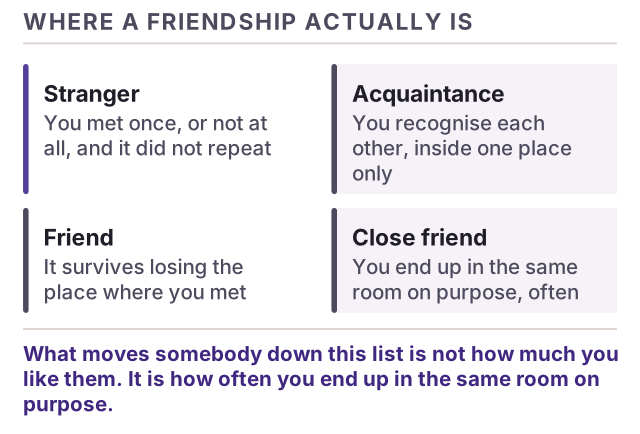
Until your early twenties, friendship was supplied rather than built. School and university gave you three things at once — the same people, in the same place, every week — and nobody had to arrange any of it. Friendships formed as a by-product of attendance.
Adult life removes all three and replaces none of them. Work looks like a substitute and mostly is not: colleagues are the same people in the same place, but the relationship is bounded by the building, and it usually ends when the job does. Everything else — moving, a long relationship, small children, a whole cohort getting busy at the same time — quietly removes more of the structure without anyone noticing at the time.
Which is why the common experience is not a dramatic loss but a slow discovery: at some point you look up and cannot name anyone you would call on a Tuesday. Almost nobody arrives there through a personal failure. They arrive there because the infrastructure went and nothing was built in its place.
Consider someone who moved twice for work in their late twenties, changed industries at thirty-four, and had a child at thirty-six. Nothing on that list is a mistake, and none of it is unusual. Each item removed one of the places where the same faces recurred, and nothing was scheduled to replace them.
That is good news, in the only way that matters: a missing structure can be rebuilt deliberately, and the method is unglamorous enough to be reliable.
How do adults realistically make friends?
By going somewhere the same people keep turning up, going back often enough to be recognised, and then asking one of them to something small. That is the whole method, in three steps; almost every page on this site is a longer version of them. They are in this order because the third one goes badly when the first two have been skipped.
One
Find somewhere you go back to
Not an event — a fixture. A weekly class, a team, a volunteer shift, a choir. The single property that decides whether a place produces friends is whether the same faces are there when you return.
The venues, ranked honestlyTwo
Go back eight times
Recognition starts around the fourth or fifth visit; real conversation somewhere after that. Most people quit at the second, conclude the group was cliquey, and leave before the mechanism has started.
How friendships actually formThree
Ask one person to something small
A coffee after, a walk, an hour. Specific, soon, easy to decline. This is the only part that requires an explicit bid, which is exactly why it is the part everyone skips — and the part that decides everything.
From acquaintance to friend
Where does this start for you?
The method above is the same for everybody. The first move is not: what differs is which piece of structure went missing, and that is usually obvious the moment it is named. Six ordinary starting points are below, each leading to the page that handles it properly. If none of them is yours, the plain version of the whole sequence lives in making friends as an adult, and the reasons a circle disappears in the first place are in why do I have no friends.
You have just moved
Everything recurring in your week stayed behind in one afternoon, and nothing replaces it by itself. The first months after a move are unusually easy to use and unusually easy to spend on nothing.
The first three monthsWork stopped supplying people
A job is the last place adults see the same faces without arranging it, which is why losing one — or moving it home — takes a social life with it that nobody counted as one.
What the building suppliesThe group scattered
Nobody fell out. People moved, had children, changed shifts, and the standing arrangement quietly stopped standing. Drift is the default ending, and it is the one that gets mistaken for a verdict.
What drift actually isYou already like people you never see outside
The shortest route to a friend usually runs through somebody you already nod to every week. What it needs is one invitation to somewhere else, which is the step almost everyone skips.
The step most advice skipsThe problem is the going, not the where
When the barrier is dread rather than logistics, choosing the right kind of room does more than any technique for being interesting — and there is a point where this stops being a social question.
Adjustments that workA friendship ended
One person leaving can take a whole set of Saturdays with them, and there is no accepted way to say so out loud. That missing vocabulary is most of why it lands as hard as it does.
When a friendship ends
You do not need to be memorable.
You need to be there every Tuesday.
Do you really lose half your friends every seven years?
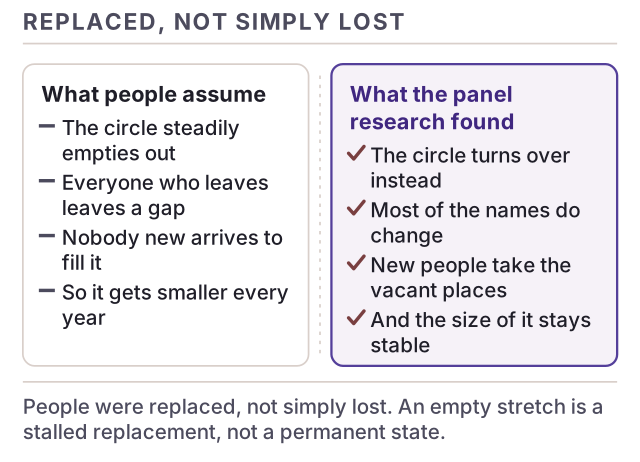
No — the line that circulates about losing half your friends every seven years drops the half of the finding that matters. It rests on a real study reported by Utrecht University in 2009: 1,007 Dutch adults aged 18 to 65, of whom 604 were re-interviewed seven years later. Seven years on, 48% of the people in someone's network were still in it — and the size of those networks stayed strikingly stable. That is a Dutch sample, and it describes turnover, not decline.
Making friends is only half of it. What keeps one going?
Nearly everything written about adult friendship is about acquisition — where to go, what to say, how to ask. The half that decides how many friends you have in ten years is maintenance, and it gets far less attention because there is nothing dramatic in it.
What keeps an adult friendship alive is not intensity, and it is not being interesting. It is a small number of arrangements: something in the diary that repeats without anyone having to remember to start it; a reply that contains a date rather than a sentiment; a concrete offer instead of let me know if you need anything; and a message with something in it the other person can actually answer. Not one of those is a conversation about the friendship. All of them survive a year in which nobody has time, which is the only test that matters.
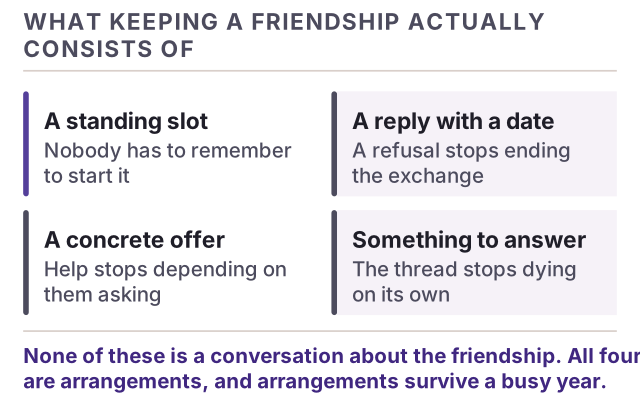
Drift is what happens when all four stop at once, and it happens without anybody deciding anything — which is why it is noticed late and then read as a verdict on the friendship. It usually is not one. Growing apart from friends separates drift from an actual ending, because the two need opposite responses. How to be a better friend is this maintenance half in full. Where a friendship keeps leaving you worse off than it found you, the useful move is to read the repeated behaviour rather than the person. And where the silence has already run for years, it is far more recoverable than it feels from inside: what to write after years of not writing.
What does this site refuse to do?
Three things, and each of them is a limit on what an article can honestly claim rather than a style choice.
No verdicts about people
Not about you, and not about your friends. Pages here describe behaviour and what it does — never what kind of person somebody is. The most-read page in this genre is usually a list of labels to apply to someone, and it leaves the reader with nothing to do except cut people off.
No numbers without a source
The two figures everyone repeats in this subject — the hours it takes to make a friend, and the half-your-friends-every-seven-years line — are both traceable, and both are routinely quoted stripped of the group they describe. Where a figure appears here, the population comes with it.
Not therapy
Loneliness borders on things a website has no business addressing. Where a question is really about health rather than social logistics — persistent low mood, dread, months without change — the page says so and points somewhere better, rather than offering another article.
Why this site exists, and who writes it
I have had to build a circle from nobody more than once, and what I wanted then was not encouragement. It was somebody telling me plainly what was actually available on a Wednesday evening, in what order, and which part of it everybody skips.
That is what a page here tries to be. The missing piece is almost always structure rather than character, so the pages describe structure: where the same faces recur, how often turning up has to happen before asking somebody to something stops being a leap, and what keeping a friendship actually involves once nothing schedules it for you. It is also why a page can be unhelpful on purpose. No verdicts about people, because a list of labels to apply to somebody leaves you with nothing to do except cut people off. No message that promises a reply. And no test for loneliness — where the real question is about health rather than a social calendar, the page says so and names who it belongs to.
Gareth Padfield Editor · started over more than once

A pen name for this site’s editorial team. The portrait on the about page is AI-generated and not a photograph of a living person, and there is no licence, therapy training or professional title behind the name.
Questions people ask about adult friendship
- What is the hardest age to make friends?
No particular age is. What changes with age is how much of your week repeats without you arranging it, and that collapses at different points for different people: a move, a change of industry, a first child, a whole cohort getting busy at once. The thirties are the usual answer because several of those tend to land within a few years of each other.
What changes by decade- Why do I struggle to make friends?
Almost always because the machinery that used to produce friendships is gone and nothing was built in its place — not because of anything about you. Doing it now takes a decision, a place that repeats, and an explicit invitation. All three were previously supplied for free, and nobody is taught to arrange them.
The usual, boring reasons- Can you make friends online, or does it have to be in person?
Interest communities, servers and forums produce real friendships, and by exactly the same mechanism as anywhere else: the same people, in the same place, repeatedly. What they do not produce on their own is the second meeting. Somebody has to propose the call, the game night or the visit, and on the apps that somebody is usually you.
Making friends online
Another twenty questions, answered the same way, are on the questions page.
By email
Tell me when there is a new guide
A short note when a guide goes up or an existing one is rewritten — what changed and whether it is worth re-reading. That is the whole thing.
One address, nothing else. No cadence promised — some months there is nothing worth sending. Unsubscribe from any email.