
Most guides to making friends answer one question — where do I meet people — and stop. That is the easy half. Meeting people is a logistics problem with obvious solutions. The hard half is what happens after a good conversation with a stranger, when you both say “we should do this again”, and then neither of you does anything.
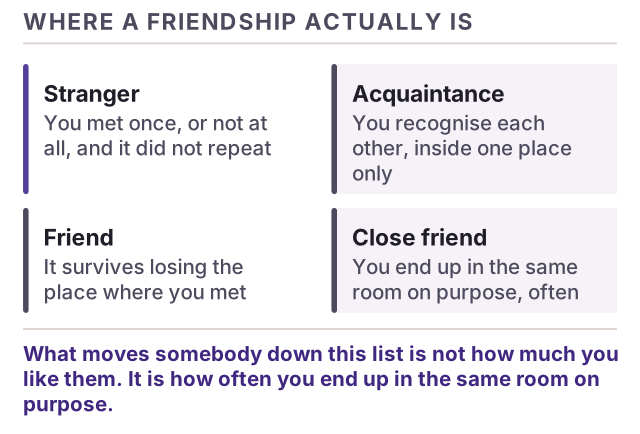
Making friends is the process of turning repeated contact with the same people into relationships that survive the place you met them. This page is about the whole sequence, including the middle.
What actually turns a stranger into a friend?
Three things turn a stranger into a friend: repetition, a shared activity, and somebody willing to suggest the next meeting. Only the third is optional in the short term.
Repetition. You need to see the same person more than once, without either of you engineering it. This is the ingredient adult life quietly removed. School, university and, for some people, an office supplied it automatically; almost nothing else does. For instance, a Tuesday class you attend for two months puts you in a room with the same people eight times without either of you arranging a single meeting.
A shared activity. Not a shared interest — an activity. Two people who both like films are not friends. Two people who go to the same weekly film night are on their way. The activity gives you something to talk about that is not yourselves, which is what makes early conversation survivable.
Someone willing to escalate. At some point, one of you has to suggest something outside the container where you met. This is the step almost everyone skips, and the reason so many pleasant acquaintances stay acquaintances for years.
Research on how new friendships form gives a sense of the scale involved. In a 2018 study in the Journal of Social and Personal Relationships, people needed roughly 50 hours together before describing someone as a casual friend, and around 90 hours before calling them a friend outright. Those hours are averages from self-report by two specific groups — 355 US adults who had moved city within the previous six months, and 112 first-year students at the University of Kansas — so they are not a law of nature. But they are a useful corrective to the idea that friendship should click into place after two coffees.
The same research makes a point that gets dropped when the numbers get quoted: hours spent working alongside someone count for much less than hours spent doing something together for its own sake. Time is necessary. It is not sufficient.
Where do adults actually meet people?
Adults meet people in the places they go back to on a schedule — a class, a team, a shift, a rota — far more than at anything they attend once. The honest ranking is by how often you return, not by how promising the place sounds.
- Anything with a fixed weekly slot — a class, a team, a choir, a volunteer shift, a gym session with a set time. High return rate, same faces, low pressure. This is the strongest category by a wide margin.
- Anything organised around producing something, such as a group project, a community garden, a repair café or amateur theatre. Shared work manufactures conversation.
- Friends of friends. Efficient, because someone has already vouched for both of you. Underused, because it requires asking.
- One-off events, meetups, parties. Fine for meeting people, weak for making friends, because there is no built-in second occasion.
- Apps built for friendship. Real, and worth a page of their own, but they solve the meeting problem and leave the harder half untouched.
The pattern is not subtle. Everything at the top of that list has a schedule attached.
How do you start a conversation without it being strange?
You start a conversation by having a reason to be talking that is not “I want to make friends”. The activity supplies it. You are asking about the equipment, the route, the assignment, the recipe, the thing you are both looking at. Small talk gets criticised for being trivial, but triviality is the point: it is a low-stakes way for two people to find out whether they enjoy each other’s company.
Two things help more than any script.
Ask a question that cannot be answered in one word. Not “have you been coming long?” but “how did you get into this?” — people generally like explaining how they arrived somewhere.
Say your own name early and use theirs. It sounds trivial. It removes the awkward ten minutes where neither of you can address the other.
How do you get from a conversation to a second meeting?
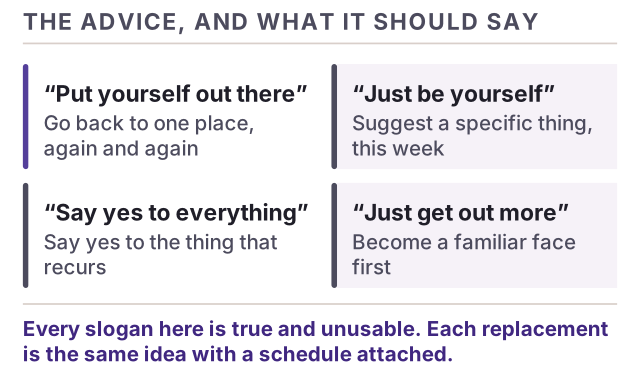
You get from a conversation to a second meeting by making one move: suggest something specific, soon, and low-cost. That is the whole game.
Specific beats open. Consider the difference between two sentences said at the end of the same evening. “We should get coffee sometime” is a pleasantry and both people know it. “There’s a coffee place next door — I’m going after this, want to come?” is an invitation. It has a time, a place and an exit.
Soon beats later. The window where a stranger will accept an invitation from you is measured in days, not months, because the memory of enjoying the conversation fades and the invitation starts to look like it came from nowhere.
Low-cost beats impressive. A walk, a coffee, an hour at the thing you were both already doing. You are not proposing a friendship; you are proposing forty minutes.
And then — the part nobody says out loud — you probably have to do it again. The first invitation gets a good conversation. The third or fourth is where something starts to feel like a friendship. Somebody has to carry the early asymmetry, and if you are the one reading a page about how to make friends, it is going to be you for a while. That is not unfair. It is just what starting looks like.
What if you invite someone and nothing comes of it?
If you invite someone and nothing comes of it, read the reply rather than the outcome.
A no that arrives with an alternative — “can’t this week, are you around next Thursday?” — is a yes with a scheduling problem. A no that arrives alone, twice, is an answer. Neither is a verdict on you, and treating a single unanswered message as evidence about your worth is a much bigger error than the failed invitation.
The realistic ratio is worth stating plainly: most attempts do not become friendships. That is true for everyone, including people who appear to have effortless social lives. They are not succeeding more often; they are attempting more often, usually inside a structure that keeps supplying candidates.
How long does this take?
Making friends from a standing start is a matter of months — longer than it feels like it should, and the timescale is the main reason people give up.
If you are starting from nobody in a new place, a realistic horizon is months, not weeks: a couple of months of showing up to establish familiar faces, then a few more of intermittent invitations before anyone is a friend in the sense you mean. What makes the difference is not intensity but persistence — the same group, the same evening, for long enough that your presence stops being noteworthy.
Where this page stops
This is a page about the mechanics of an ordinary social problem. If the difficulty is not logistics but dread — if the thought of a conversation with a stranger produces symptoms rather than reluctance, or if isolation has stopped feeling like a situation and started feeling like a fact about you — that is a different question, and a website is the wrong tool for it. Talking to a GP or a therapist is a reasonable next step and not an admission of anything.
For everything else, the practical routes are split by situation: making friends in a new city, when you are starting from nobody at all, and turning the acquaintances you already have into actual friends.