
Friendship apps are platforms built to introduce adults who are looking for platonic friends rather than dates. They occupy an odd position. They are the most direct answer to the problem — an app whose entire purpose is introducing adults who want friends — and they have a reputation among people who have tried them for producing a lot of activity and not many friends.
Both things are true, and the reason is structural rather than a failure of any particular product.
What they actually solve
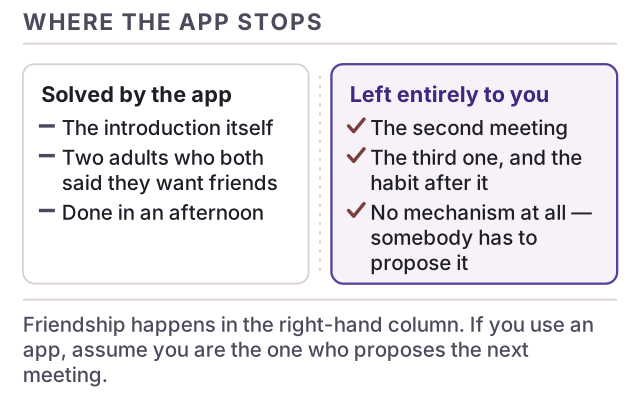
The introduction problem, and they solve it well.
For an adult who has just moved, changed careers, come out of a long relationship or otherwise found themselves without a circle, the hardest single step is arranging a first meeting with someone who is explicitly also looking. Ordinary life supplies almost no way to do this. There is no polite way to ask a stranger in a shop whether they would like to be friends, and joining a club takes weeks before it produces a conversation.
An app removes that in an afternoon. Everyone on it has already declared the intention, which eliminates the single most awkward part of adult friendship: not knowing whether the other person is looking for the same thing.
That is a genuine service and it should not be dismissed.
Why do friendship app matches never lead anywhere?
Usually because nobody proposes a second meeting. The app solves the introduction and leaves everything after the first meeting alone.
Friendship is built from repeated contact — the same person, more than once, without either of you having to reconstruct the reason each time. An app produces one meeting. It has no mechanism at all for producing the second, the fourth or the tenth, which is where friendship actually happens.
This is why the common experience is a run of perfectly nice coffees with interesting people, none of whom you ever see again. Nothing went wrong. Both parties enjoyed it, both said “we should do this again”, and neither had a structure that would make it happen. A weekly class gets you back in the same room automatically; an app requires somebody to consciously initiate every single time. Consider two people who spend a good hour over coffee, both say they enjoyed it, and both then wait to be asked again: nothing has gone wrong with either of them, and there is nothing in the app that will arrange the next meeting on their behalf.
The practical consequence: if you use one of these apps, you are the mechanism. Assume you will propose the second meeting, and probably the third.
What kinds of friendship apps are there?
Roughly three: one-to-one matching apps, event and group apps, and interest communities that are social networks first.
One-to-one matching. Works like a dating app with the romance removed: profiles, swiping, a chat, a coffee. Best at the introduction problem, worst at repetition. Requires the most deliberate follow-up from you.
Events and groups. Puts you in a room with several people around an activity or a shared plan. Weaker introductions — you may not talk to everyone — but far better conversion, because groups often recur and recurrence is the thing you actually need.
Interest communities. Social platforms first, meeting places second: a forum or server built around a hobby, such as a woodworking board or a regional games server, with local branches. Slowest, and the strongest when it works, because you have both a shared subject and repeated contact before you ever meet.
If you can only use one, the middle category is the best bet for friendship specifically, for the same reason a weekly class outperforms a party.
Using one without wasting six months
Treat matches as a supplement, not a strategy. The strongest combination is one app plus one recurring in-person activity. The app produces candidates; the activity produces the repetition. On its own, the app rarely produces either.
Propose something specific and small. The same rule as everywhere else: a named coffee place, a time, an hour. For example, “coffee at the place by the station, Saturday at eleven” gives the other person something to say yes to. Open-ended “we should meet up” dissolves in chat.
Move to a meeting quickly. Long text exchanges build a version of someone that the real meeting has to compete with. A week or two of messages is plenty.
Suggest the second meeting at the first. This is the highest-leverage habit available. While you are both sitting there having enjoyed it, name a next thing. Afterwards it requires courage; during, it is a natural remark.
Do not audition. The interview-shaped first meeting — where both people run through their credentials — is the most common failure mode. It is a coffee, not a screening.
Should I pay for a friendship app?
Only after a free version has produced actual meetings for you.
This page does not carry prices, and that is deliberate: app pricing changes frequently by market and tier, and a stale figure published confidently is worse than no figure. Anything quoted here would need a verification date attached, and until it has one it does not go on the page.
What can be said without a price list: the free tier of most of these apps is enough to find out whether the format works for you, and the paid tiers mostly sell volume — more matches, more visibility, more reach. Volume is rarely the binding constraint. The constraint is the second meeting, and no subscription fixes that.
Are friendship apps safe to use?
The same ordinary precautions apply as with any meeting arranged online, and a platonic framing changes none of them.
Meeting someone from the internet is ordinary now, and the ordinary precautions still apply: somewhere public the first time, tell someone where you are going, your own transport there and back, and leave whenever you like without needing a reason. A platonic framing does not change any of that, and nobody reasonable will be offended by it.
Where to go from here
If the app is producing meetings that go nowhere, the missing skill is turning an acquaintance into a friend — specifically, the second invitation. If you would rather build the repeating structure first and let people come from it, where adults actually meet people ranks the options by how reliably they produce the same faces. And if you have just arrived somewhere new, apps are at their most useful in the first three months.