Statistics we cite
Every number published on makefriendsguide, verified against a primary source. Each entry has a permalink — cite a single statistic by linking its anchor. Last verification: 2026-08-21.
- about 50 hours — It took roughly 50 hours of time together for two people to move from acquaintance to casual friend#
- Source: Journal of Social and Personal Relationships (2018) · verified 2026-08-21
- about 90 hours — Around 90 hours of time together preceded people calling someone a friend rather than an acquaintance#
- Source: Journal of Social and Personal Relationships (2018) · verified 2026-08-21
- more than 200 hours — More than 200 hours of time together preceded people describing someone as a close friend#
- Source: Journal of Social and Personal Relationships (2018) · verified 2026-08-21
- 48% — Seven years after the first interview, only 48% of the people in someone's personal network were still in it#
- Source: Utrecht University (2009) · verified 2026-08-21
- 30% — Only 30% of the discussion partners and practical helpers still held the same position in a person's network seven years later#
- Source: Utrecht University (2009) · verified 2026-08-21
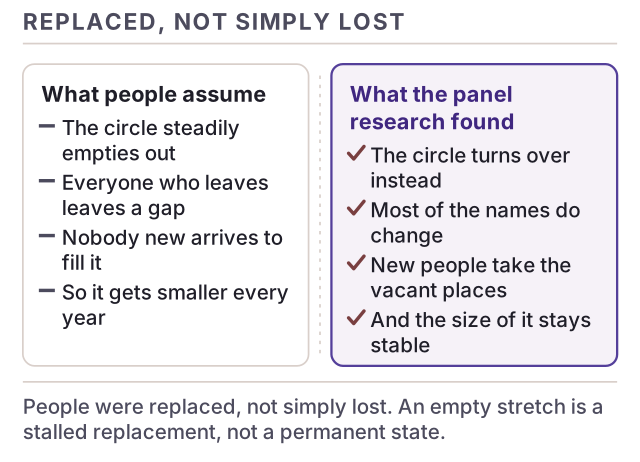
Why are there so few numbers here?
Because most of the figures that circulate about adult friendship could not be traced to a primary source. This niche runs on two pieces of folklore in particular — that it takes 200 hours to make a best friend, and that you lose half your friends every seven years. Both are distortions of real research: the first turns an average from two small self-report samples into a rule, and the second drops the finding that makes the original meaningful, which is that network size stayed stable. Neither phrasing appears on this site. The full list of what we rejected, and why, is on the sources page.
Can I cite these figures?
Yes, with attribution and a link to this page or to the primary source. Every entry above carries the population the figure actually describes, because the population is the part that is usually dropped in retelling — and dropping it is what turns a finding into folklore. Methodology: see the editorial policy.