
Making friends as an adult is the deliberate reconstruction of three conditions that used to arrive for free: seeing the same people, in the same place, on a schedule nobody had to arrange. School, university and some workplaces supplied all three at once. Almost nothing in ordinary adult life supplies any of them, which is why a problem that once solved itself now has to be worked at — and why working at it feels strange.
That framing matters more than any technique, because it changes what the difficulty is evidence of. A missing structure is a logistics problem. It is not a report on how likeable somebody is, and treating it as one is the single most common way people talk themselves out of the attempt.
What does making friends as an adult actually involve?
Three ingredients, and only the third is optional in the short term.
Repetition. You need to end up near the same person more than once without either of you engineering it. This is the ingredient adulthood quietly removed, and it is the one every other part depends on.
A shared activity. Not a shared interest — an activity. Two people who both like cycling are not friends; two people on the same Thursday ride are on their way. The activity supplies something to talk about that is not yourselves, which is what makes early conversation survivable for both of you.
One person willing to suggest the next thing. At some point somebody has to propose something outside the container where you met. This is the step almost every guide skips, and the reason so many perfectly pleasant acquaintances stay acquaintances for years.
Notice what is not on that list: charisma, an interesting hobby, a script for small talk, or any particular personality. Those things change how the early minutes feel. They do not change whether a friendship forms, because friendships form out of recurrence.
Why is making friends as an adult harder than it was at school?
Because three supports were removed at once, and nothing replaced them.
The first was enforced proximity — the same room, the same timetable, no opt-out. The second was unstructured time: the gaps between things where conversation happens without being scheduled. The third was a shared, obvious pretext for being together, so that nobody had to explain why they were talking to anybody.
Adult life deletes all three and hands back a calendar you control. Control sounds like an improvement, and for most things it is. For friendship it is a downgrade, because the thing that made school work was precisely that nobody was choosing.
Consider what this means for the most common piece of advice in the genre — put yourself out there. It names the outcome and skips the mechanism. Putting yourself out there once, at an event with a hundred strangers you will never see again, produces nothing. Going to a twelve-person class eight weeks running produces recognition, then conversation, then sometimes a friend. Same effort, different structure, completely different result.
How long does it take to make a friend as an adult?
Longer than it feels like it should, and the mismatch between expectation and reality is the main reason people quit.
A 2018 study in the Journal of Social and Personal Relationships gives a sense of the scale. Among the people it surveyed, roughly 50 hours of time together preceded someone being described as a casual friend, around 90 hours preceded the word friend, and more than 200 hours preceded close friend. Those figures come from two specific groups — 355 US adults who had moved city within the previous six months, and 112 first-year students at the University of Kansas — so they describe those samples, not humanity. They are averages from self-report, not thresholds anyone crosses on schedule.
Two caveats travel with the numbers and are usually dropped when they get quoted. First, the research is explicit that hours spent working alongside somebody count for far less than hours spent doing something together for its own sake. Second, time is necessary but not sufficient: you can accumulate a great many hours near a person and remain acquaintances, because nobody ever suggested the thing outside the container.
The practical translation is a horizon of months rather than weeks. For instance, someone starting from nobody in a new city might spend two months simply becoming a familiar face, another two exchanging real conversation, and only then find that one of those people has become someone they would call.
What is the step almost everyone skips?
Turning a good conversation into a second occasion. It is one move, and it has three properties.
Specific beats open. “We should get coffee sometime” is a pleasantry and both people know it. “There’s a place next door, I’m going after this — want to come?” is an invitation. It has a time, a place, and an exit.
Soon beats later. The window in which a near-stranger will accept an invitation from you is measured in days. After a few weeks the memory of enjoying the conversation has faded and the invitation arrives from nowhere.
Small beats impressive. A walk, a coffee, an hour at the thing you were both already doing. You are not proposing a friendship. You are proposing forty minutes.
And then, usually, you have to do it again. The first invitation produces a nice afternoon. Somewhere around the third or fourth, the relationship stops needing to be organised. Whoever is reading a page like this one is going to be the one carrying that asymmetry for a while, which is not unfair — it is what starting looks like.
What if the invitations do not land?
Read the reply rather than the outcome. A no that arrives with an alternative — “can’t this week, are you around next Thursday?” — is a yes with a scheduling problem. A no that arrives alone, twice, with nothing offered back, has answered a different question. Neither is a verdict on you.
The honest ratio is worth saying plainly: plenty of attempts do not become friendships, for everybody, including people whose social lives look effortless. They are not succeeding at a higher rate. They are attempting more often, usually inside a structure that keeps supplying candidates.
That structure is also why this is never finished. A panel study reported by Utrecht University in 2009 re-interviewed 604 Dutch adults seven years after an initial survey of 1,007 people aged 18 to 65 and found that 48% of the people in someone’s personal network were still in it — while the size of those networks stayed strikingly stable. That is a Dutch sample, and it describes replacement rather than decline: people leave a circle continuously, and the circle only shrinks if nothing is supplying new ones. Which is an argument for keeping one recurring thing on the calendar long after the immediate problem is solved.
Where do these pages go next?
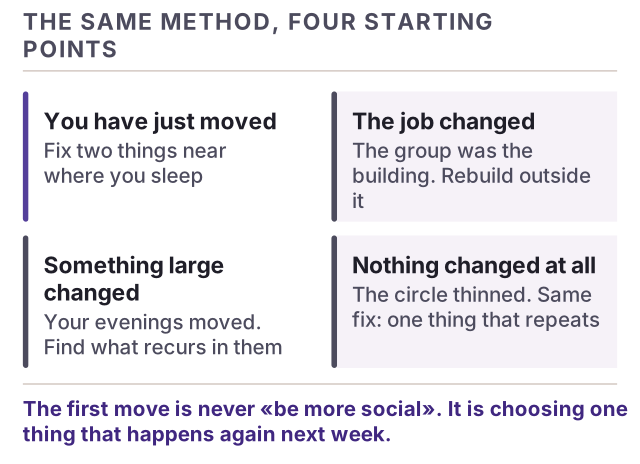
This section is organised by the situation you are actually in, because the mechanics are constant and the constraints are not.
If the question is how friendships form at all — the full sequence, from first conversation to something that survives — start with how to make friends. If the question is where to go, the venues are ranked by how often you return to them rather than how promising they sound, on where to meet people.
Situations get their own pages because their constraints differ. There is one for a new city, where the first ninety days matter disproportionately; one for making friends in your thirties and the decades either side of it, where the obstacle is competing obligations rather than opportunity; one for work, where the container is real but has an expiry date built into it; and one for social anxiety, where the difficulty is not logistics.
Two pages cover the routes that get treated as shortcuts. Making friends online is about communities and shared interests rather than matching, such as a long-running forum, a Discord for a hobby, or a game you play with the same group every week. Friendship apps get an honest assessment of what they solve, which is the meeting problem, and what they leave untouched, which is everything after it.
And the page that most guides do not have: from acquaintance to friend, on the gap between knowing someone and being friends with them.
If the circle is not thin but gone — nobody to call at all — that situation has its own section. If the people are there but drifting, the keeping friendships section covers maintenance, repair and endings.
Where this section stops
These pages are about the mechanics of an ordinary social problem, and they assume that the obstacle is structural. If the obstacle is dread rather than logistics — if the thought of a conversation with a stranger produces physical symptoms, or if being alone has stopped feeling like a situation and started feeling like a fact about you — that is a different question and a website is the wrong tool for it. Talking to a GP or a therapist is a reasonable next step, and not an admission of anything.