
Making friends in your 30s is the same mechanism as at any other age — repeated contact, around a shared activity, with somebody willing to suggest the next thing — run against a calendar with far less room in it. The advice itself does not really change with age; it is the same at twenty-five and at forty-five.
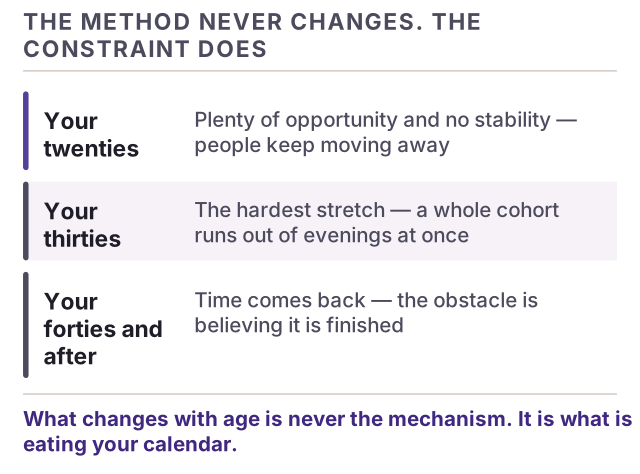
What changes is the constraint. Each decade removes a different resource, and the useful adjustments are different as a result.
How do you make friends in your 20s?
Build around a place rather than a job, and keep meeting people, because this is the decade in which everyone keeps moving.
The twenties are socially rich and structurally unstable. People are still leaving education with intact friendship groups, still have flexible evenings, and are still in a phase where new friendships form quickly.
The problem is churn. People move for work, move in with partners, move back home, move abroad. A group assembled at twenty-four can be scattered across three cities by twenty-eight, and each move takes a few relationships with it.
What helps:
- Build around a place, not a job. Jobs change more often than neighbourhoods at this age, and work friendships tend to end with the contract.
- Assume some friendships are seasonal. This is not cynicism — it is the reason to keep meeting people rather than assuming the current group is permanent.
- Keep one thing that survives moves. A game, a call, a group chat with an actual purpose. Long-distance friendships need a mechanism just as local ones do.
Why is it so hard to make friends in your 30s?
Because a whole cohort acquires demanding jobs, small children and caring responsibilities within the same few years, so the free evenings of an entire social group collapse at once.
This is the decade the question gets asked about, and the explanation is not mysterious.
Between roughly thirty and forty, a whole cohort acquires demanding jobs, small children, mortgages and, increasingly, ageing parents. This happens to everyone at once, so the collective free evenings of an entire social group collapse simultaneously. The experience from inside is that all your friends became distant. Nobody did. The hours vanished.
That collides with what a friendship costs in time. A 2018 study in the Journal of Social and Personal Relationships asked 355 US adults who had moved city within the previous six months, and 112 first-year students at the University of Kansas, how many hours they had spent with the people they now placed at each level of closeness. On average it took around 50 hours together before someone counted as a casual friend, about 90 hours before a friend, and more than 200 before a close friend. These are averages from self-report rather than a rule, and one caveat travels with them: hours of shared leisure did the work, while hours spent working alongside someone largely did not. Set against a decade in which the free evenings have collapsed, that is the arithmetic of the problem.
Two consequences follow, and both matter.
Spontaneity ends. Nothing happens without being scheduled, usually weeks ahead. This feels cold if you came from a decade of same-day plans, and it is not coldness — it is logistics.
Old friendships go dormant fast. Two declined invitations in a row is now enough for six months of silence, because neither person has slack to re-initiate. That is drift, and it accounts for most friendship loss in this decade.
What actually works at thirty-something:
- Recurring beats occasional. A fixed slot — the first Tuesday, the Thursday five-a-side, the monthly dinner — survives a full calendar because it never has to be reorganised. “We must catch up soon” does not survive it at all.
- Combine, do not add. Exercise with a friend, volunteer with a friend, take the kids somewhere with another parent. For example, a walk to the shops with someone is one slot doing two jobs, while a new evening class is a third obligation competing with the other two. New separate commitments get dropped first; merged ones stick.
- Lower the bar for what counts. A half-hour walk and a phone call on the commute are contact. Waiting for a free evening means waiting until the children leave home.
- Reply to a no with a date. In this decade specifically, this single habit does more than everything else combined.
Is it too late to make friends at 40?
No, and in some ways it is easier than at thirty.
Something unexpected happens in the forties: time starts coming back. Careers stabilise, children become independent, and evenings reappear.
The obstacle by then is rarely availability. It is the belief that the social part of life is settled — that friendships are things you have from earlier, and new ones are for the young. That belief is wrong and it is self-fulfilling, because people who hold it stop attending anything where new people are.
What helps:
- Assume it still works. The mechanism is unchanged: same room, same people, repeatedly.
- Choose activities with a mixed age range, such as community organisations, choirs, volunteering and sports clubs. Age-segregated settings are the exception in adult life, not the rule.
- Re-open the dormant ones. In this decade the highest-return move is often not a stranger but someone you were close to fifteen years ago.
Do people stop making new friends after 30?
Many people stop trying rather than stop being able to; the mechanism itself is unchanged.
Strip away the decade-specific adjustments and the same three things decide it:
- Somewhere you return to. A schedule, the same faces. This is the engine at twenty-two and at forty-two.
- Somebody willing to escalate. The invitation outside the container. Adult life gives nobody practice at this, so it stays awkward at every age — and it is still the step that decides everything.
- A realistic timescale. Months, not weeks. What changes with age is that people expect it to be quicker than it was, and quit sooner.
What does not work at any age
Waiting for it to happen naturally. It happened naturally when school and university supplied the structure. Nothing supplies it now.
One big effort. Consider a single evening of determined socialising set against eight ordinary Tuesdays: the evening produces nothing, and the Tuesdays produce a social circle.
Choosing by interest instead of by schedule. The genuinely fascinating group that meets twice a year loses to the mildly interesting one that meets weekly. Recurrence is the active ingredient.
Where to go from here
For the venue question in detail, see where adults actually meet people. If you have recently moved, the sequence is different and has its own page. And if the honest situation is that there is nobody at all rather than a thinning circle, start here.