
Moving to a new city is the one situation where making friends is both harder and easier than usual. Harder because you are starting from zero, with no existing circle to lean on. Easier because you have something almost no other adult has: a legitimate, socially accepted reason to be looking.
That reason has a shelf life, which is why the sequence matters. Making friends in a new city is the work of rebuilding, from nothing, the repeated contact your old place supplied without your noticing — and doing it while being new still explains why you are looking.
Why are the first three months after a move different?
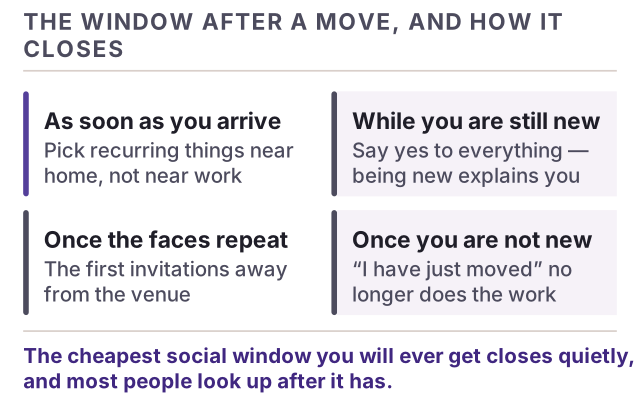
The first three months are different because “I’ve just moved here” explains your presence, your questions and your invitations in a single sentence. For roughly your first season in a new place, that one sentence does an enormous amount of work. It explains why you are at the thing alone. It explains why you are asking questions. It invites people to be helpful, which most people quite like being. And crucially, it makes an invitation from you read as reasonable rather than forward.
That window closes gradually. At eight months you are no longer new, and the same conversations require you to supply the context yourself.
None of this means a slower start is fatal. It means that if you have just arrived, the cheapest social effort of your life is available right now, and it is worth spending deliberately rather than waiting until you have unpacked, found a routine, and settled in — which is exactly when most people finally look up and discover they know nobody.
What should I do in the first month after moving?
In the first month, commit to two recurring activities near where you live rather than trying to find individual friends. The instinct is to look for friends. The better move is to look for containers — places that will produce the same faces on a schedule without you having to organise anything.
Two is the right number. One is fragile: if it turns out to be a bad fit, you are back at zero and it is now March. Three is usually more than a new job and an unfamiliar commute will allow.
What makes a good container in a new city specifically:
- Close to home, not close to work. A friendship built near your office collapses if you change jobs, and it rarely produces the kind of weekend proximity that makes people call each other.
- Weekly, fixed slot. The repetition is the entire mechanism.
- Low skill floor. You want somewhere you can be mediocre in public, because the alternative is not going.
- Talking is built in. Anything where silence would be strange, such as team sports, classes with pair work, volunteering, choirs or board-game nights.
And then the rule that decides everything: attend eight times before evaluating it. New people conclude a group is cliquey at visit two, which is precisely when everyone there is still working out whether you will come back.
How do you meet people in a new city where you know nobody?
When you know nobody, you get to people through the connections you already have — colleagues, friends of friends, anyone with a thread to this city. The standard route into a new city is not a stranger at an event. It is a chain of people who barely know each other.
Before you arrive, and in your first weeks, work through:
- Colleagues. Ask the person who has lived there longest where they go. This is a genuinely useful question and it flatters them.
- Friends of friends. Post the fact that you have moved and ask, plainly, whether anyone knows someone here. This works far more often than people expect, because everybody knows somebody somewhere.
- Anyone from the old place who moved here first. Even someone you were not close to. Shared origin is a surprisingly durable bond in a new city.
- Neighbours. Weak in most places, strong in some, and free to try.
The ask should be small and specific: not “introduce me to your friends” but “I’ve just moved here — what’s worth doing on a weekend?” or “if you’re ever getting a coffee, I’d like to join”. You are asking for information and giving them the option to escalate it.
Say yes to everything, for a while
For the first two months, accept invitations you would normally decline. For instance, the drinks with a colleague you are lukewarm about, the birthday of someone you have met once, the event that sounds mildly boring.
This is temporary and strategic. You are not building a social life out of these events; you are buying reach into networks you cannot otherwise see, and you are establishing yourself as someone who turns up. A person who says no twice stops being invited, and in a new city you cannot afford to be dropped from a list you have only just been added to.
After a few months you can be selective again. At the start, breadth beats taste.
The trap: living in the old city by phone
The most common way a move fails socially has nothing to do with the new city. It is spending every evening on video calls with the people you left.
Those calls feel social, are comfortable, and cost nothing emotionally. They also fill exactly the hours in which you would otherwise be at the badminton club being mildly uncomfortable among strangers. Imagine six months of that pattern: your old friendships are healthy and you know nobody within a hundred miles.
Keep the old friendships — they are the ones that already exist, and dropping them is not a strategy. But protect two or three evenings a week from them.
What about big cities specifically?
Large cities have more of everything, including more people looking for friends. They are also the places where people most often report loneliness, for a structural reason: distance and transport mean spontaneity disappears. Nobody drops in when dropping in takes an hour each way.
The adaptations that help:
- Choose by neighbourhood, not by city. Your realistic social radius is what you will cross on a wet Tuesday in February.
- Fix the day, not the plan. “Every second Thursday” survives; “let’s do something soon” does not survive a calendar with commutes in it.
- Assume longer lead times. Plans in big cities are made weeks out, which feels cold if you have come from somewhere smaller. It is not coldness — it is logistics.
How long should this take?
Making friends in a new city takes months rather than weeks — longer than the move itself. A realistic shape for the first year: a couple of months to find containers, another two or three before faces become familiar and invitations start to feel natural, and somewhere past the six-month mark before there is anyone you would call rather than text.
The scale of it has been measured on people in exactly this position. In the Journal of Social and Personal Relationships, a 2018 study asked 355 US adults who had moved city within the previous six months, plus 112 first-year students at the University of Kansas, about people they had recently met: on average, about 50 hours together came before “casual friend”, about 90 hours before “friend”, and more than 200 hours before “close friend”. Those are averages from self-report rather than targets to hit, and the study’s own caveat matters as much as the numbers — hours of shared leisure did the work, while hours spent working alongside someone largely did not.
The one-year rule is worth holding onto. The first months are not a fair sample: you are comparing a place where you know nobody to a place where you knew everybody, and any city loses that comparison.
If, after a year of genuinely showing up, the city is still empty — that is real information, and it is allowed to inform what you do next.
Where to go from here
The venue question in more detail is on where adults actually meet people. Once a few faces are familiar, the step that decides everything is turning an acquaintance into a friend. And if you moved some time ago and the circle never materialised, starting from nobody is the more honest starting point.