
Most people looking for friends do not actually need to meet anyone new. They already know a dozen people they like: a colleague two desks away, someone from the class, a neighbour, a friend of a friend they always enjoy talking to at other people’s parties. What they are missing is the mechanism that converts those people into friends — and that mechanism is a specific, slightly uncomfortable move that adult life gives almost nobody practice in. A close friend is someone you keep seeing for your own reasons once the context that introduced you is gone.
What is the difference between an acquaintance and a friend?
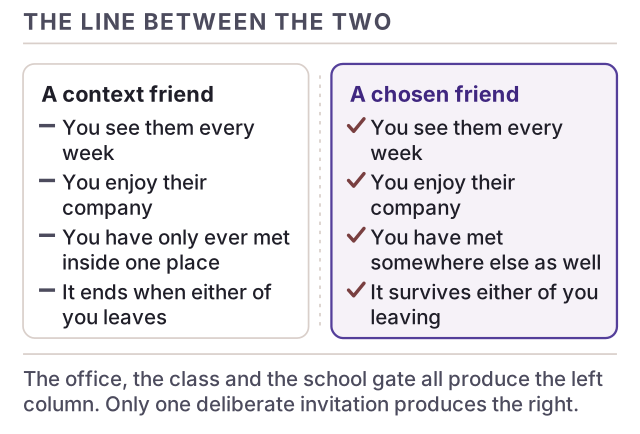
An acquaintance is somebody a context produces, and a friend is somebody who is still there when the context goes. Remove the context — you leave the job, the class ends, you move two streets away — and the relationship disappears without either person deciding anything.
What makes the difference is that at some point the two of you started meeting for your own reasons rather than the situation’s.
That is the entire distinction, and it explains a common and disorienting experience: leaving a job where you had “loads of friends” and discovering, six months later, that you have spoken to none of them. Those were context-friends. Nothing went wrong. They were simply never moved out of the building.
Why is this step so hard?
This step is hard because it is the only part of adult friendship that requires an explicit bid, and bids can be declined.
Everything before it is deniable. Chatting after class costs nothing and means nothing in particular. Consider the moment you say “do you want to get food on Thursday?”: you have declared an interest, and there is now a version of the next thirty seconds in which the other person says no. Most adults would rather stay in the pleasant, indefinite version.
There is also a rehearsal problem. Between roughly eighteen and twenty-two, most people practise this constantly. After that, invitations tend to come from established friends, in groups, about things already planned. A decade later the muscle has wasted, and a straightforward invitation feels like a much larger act than it is.
How do you actually do it?
You do it by inviting the person to something specific away from the place you normally see them, keeping it small, and doing it again a few weeks later.
Change the container. The invitation should be to something outside the place you normally overlap — such as coffee after the class rather than during it, or a walk rather than the same gym. This is the actual signal — not the words, the venue.
Keep it small and specific. “Want to grab a coffee after?” beats “we should hang out sometime” by a distance, because it has a time, a place, a duration and an obvious exit. You are proposing forty minutes, not a friendship.
Attach it to something already happening. The easiest invitations are logistical: you are both leaving anyway, both hungry, both going in the same direction. For example, you are walking to the same bus stop after the class and the coffee place is on the way. The bid is smaller when it looks like convenience.
Do it more than once. One good coffee produces a nice memory. Three produce a habit, and habits are what friendships are made of. If you stop after one because they did not reciprocate immediately, you will conclude they were not interested, when what actually happened is that neither of you has the invitation muscle.
Accept the early asymmetry. Somebody has to be the one who suggests things for the first few months. If you are reading this, it is you. That is not a bad deal; it is the cost of starting, and it usually rebalances once the friendship exists.
How does a friendship get deeper rather than just longer?
A friendship gets deeper when one person discloses slightly more than the situation demands and the other meets it rather than deflecting. Repetition makes people familiar; it does not, on its own, make them close.
This works in small increments. Someone asks how your week was; instead of “busy, you know”, you say the actual thing — the difficult conversation, the small triumph, the thing you are worried about. Nothing dramatic, one notch more real than required. Then you watch what comes back.
If they match it, the relationship has moved. If they change the subject, no harm has been done and you have learned where the ceiling is for now.
The mistake in both directions is worth naming. Too little disclosure and a friendship can run for years at the temperature of a work chat. Too much too early — treating a second coffee as a therapy session — puts the other person in a role they did not agree to. The rule of thumb: go one step past comfortable, not five.
Depth also takes an unglamorous amount of time. In the Journal of Social and Personal Relationships, a 2018 study of 355 US adults who had moved city within the previous six months and 112 first-year students at the University of Kansas found that, on average, about 90 hours together preceded calling someone a friend and more than 200 hours preceded calling them a close friend. Those are averages from self-report rather than thresholds to clear, and the same study noted that hours of shared leisure did the work, while hours spent working alongside someone largely did not.
What about the ones who are already friends but distant?
Distant friends are the cheapest place to start, because the shared history is already built. The dormant category — the person you were genuinely close to three years ago and have not messaged since — is the most underrated resource anyone has, and reviving it costs far less than beginning from zero.
It also fails softly. If a message into a long silence goes unanswered, you have lost nothing you had yesterday. That is a much better risk profile than approaching a stranger, and most people never take it. There is a separate page on reaching back out after a long gap, including what to say when the honest answer to “why now?” is “I have no friends and I miss you”.
How do you tell if it is working?
You can tell it is working when the effort stops running in one direction only. Three signals, in rough order of appearance:
- They start initiating. Not always, not immediately — but at some point invitations begin arriving as well as leaving. This is the clearest sign the balance has shifted.
- The conversation continues between meetings. A link sent for no reason, a question answered days later. Friendship is largely the maintenance of a background thread.
- You could ask for something. A lift, a favour, an opinion on something that matters. The willingness to impose slightly is one of the better definitions of a friend there is.
If none of these appear after several months and a handful of invitations, the honest read is that this person has a full life and no room — a fact about their circumstances more often than about you. It is worth noticing early, not to keep score, but so that your effort goes where there is something to build.
Where to go from here
If you do not have a stock of acquaintances to work with, the problem is a stage earlier: where adults actually meet people, and how friendships form in the first place. If the circle you had has quietly thinned out over the years rather than never existing, why friendships drift is the more useful place to start.