
The cheapest social move most adults have available is the one almost nobody makes: messaging someone they were genuinely close to, three or five or ten years ago, and have not spoken to since.
Reconnecting with old friends is restarting a friendship that went quiet rather than one that ended: no incident behind the silence, just a gap nobody scheduled across. It is cheap because the hard part is already done. You do not have to build shared history, establish trust, or find out whether you enjoy each other’s company. All of that exists. What is missing is one message.
Is it weird to message someone you have not spoken to in years?
It feels weird to send and is almost always welcome to receive.
Almost everyone in this situation runs the same interpretation: they stopped replying, so they lost interest. Meanwhile the other person is running the identical interpretation in the other direction.
Both are usually wrong. Most long silences between people who liked each other are produced by scheduling, not decisions. Someone was busy, an invitation went unreturned, a month passed, and after that any message needed a reason. The gap became self-sustaining, because the longer it runs, the more significant a message seems.
This matters practically: you are almost certainly not interrupting someone who chose to be rid of you. You are interrupting someone who assumes you chose to be rid of them.
Positions in a social life also move around more than people disappear from it. Utrecht University reported in 2009 that among 604 Dutch adults re-interviewed seven years after an initial survey of 1,007 people aged 18 to 65, 48% of the people in someone’s personal network were still present, but only 30% still held the same position — the same role as someone you discuss things with or turn to for practical help — while the average size of those networks stayed strikingly stable. Someone who stopped being the person you called first has not thereby become unreachable.
What do you say to an old friend after years of no contact?
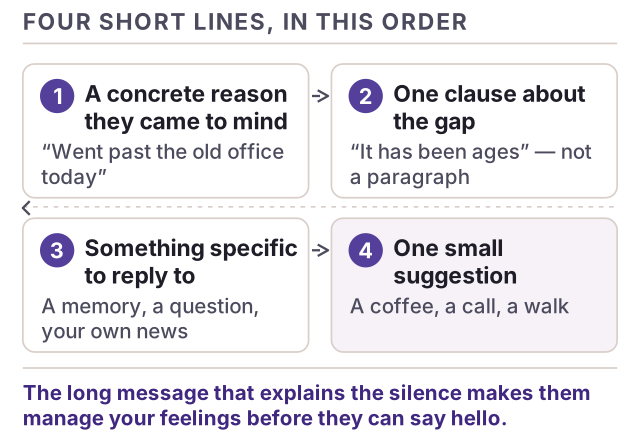
Say something short and specific: why they came to mind, one clause about the gap, something concrete to reply to, and one small suggestion.
The structure that works:
- A reason you thought of them. Concrete beats general. A place, a song, a piece of news, something you walked past. For example, “went past the old office today and thought of you” does more work than “you’ve been on my mind”.
- One line acknowledging the gap, without explaining it. “It’s been ages” or “I’m sorry I dropped off” — a clause, not a paragraph.
- Something specific to say or ask. A memory, a question, an update of your own. Give them something to reply to.
- One concrete suggestion, kept small. Something such as a coffee, a call or a walk — not an open-ended “we should catch up”.
That is four short lines, and it should be about that long.
What to avoid: the long message that accounts for the silence, apologises thoroughly, and explains everything that has happened in your life since. It reads as heavier than intended, and it puts the recipient in the position of having to manage your feelings before they can say hello.
What if the honest reason is “I have no friends”?
That is a real situation and a common one. The reflex is to hide it, which produces a slightly false, breezy message that is harder to write than the true one.
You do not need to lead with it, and you also do not need to construct a cover story. “I’ve realised I’ve let a lot of things drift and I miss talking to you” is honest, brief, and — importantly — not a request for rescue. Most people receive that well, because most people over thirty recognise the feeling.
What does not work is making the message an assessment of your own life, or arriving with an implicit request that this person fill an empty calendar. One friendship revived is one friendship. It is not a solution to isolation, and treating it as one puts weight on a relationship that has just been reawakened. If the wider situation is the real problem, that has its own page.
How to read the reply
Warm and reciprocal — they answer, ask something back, engage with the suggestion. Take it at face value and make the plan concrete quickly, while there is momentum.
Warm but vague — pleased to hear from you, no engagement with the plan. Try once more with something specific and easy: a date, a time, a place. If it dissolves again, they are glad you exist and do not have room. That is a perfectly ordinary answer.
Polite and flat — short, closed, no questions returned. This is the reply that suggests there was a reason for the silence after all, or simply that the friendship has finished its life. Leave it.
Nothing — the least informative outcome, and the one people over-read. Messages get buried; people go through periods where the inbox is a threat; numbers change. One follow-up a few weeks later is reasonable. A third is asking a question that has already been answered.
In every branch, you end no worse off than you started. That asymmetry is why this move is worth making even though it feels exposed.
How do you restart a friendship rather than just catching up once?
You arrange the second meeting, ideally while you are still at the first one, because the reunion itself uses up the occasion that made contact easy.
The reunion coffee is the easy bit. Two people who once knew each other well will always have a good two hours — there is a decade of material and the pleasure of being recognised.
Then, very often, nothing. Consider two people leaving a good reunion having agreed only that they should do this more often: nothing has been arranged, so nothing happens, and the friendship goes back to needing a reason. The catch-up used up the natural occasion and no new mechanism replaced it.
If you want the friendship rather than the evening, the second meeting is the one that matters, and it should be arranged within a month or two — ideally at the first one, while you are both there. Add a low-effort thread in between: a message, a link, an actual question. What turns a nice reunion into a live friendship is the same thing that sustains any adult friendship — some recurring mechanism that produces the next meeting without either person having to gather their courage again.
Who to start with
If several people come to mind, start with:
- The one where the silence has no incident behind it. Nothing happened; life simply intervened. Highest chance of a warm reply.
- The one you have news for. A shared acquaintance’s wedding, a move to their city, a thing they would find funny. The message writes itself.
- The one who is geographically possible. Reviving a friendship four time zones away is real but harder to convert into recurring contact.
And leave for later, or not at all, the ones where something did happen. Those are a different conversation, and they do not start with a casual message.