Having no friends means having nobody currently occupying the role of a close friend. It is a description of a situation at a point in time, not a trait, not a diagnosis, and not a statement about whether someone is likeable. That distinction is the whole reason this section exists, because almost everything written on the subject quietly slides from the first meaning to the last one.
Two things follow from taking the definition literally. A situation has causes that can be named, and a situation can change. Neither of those is true of a verdict about a person.
Why does an adult end up with no friends?
Usually through a sequence of ordinary events, none of which looked significant at the time.
Moves. Every relocation costs a circle. Friendships that ran on proximity do not survive distance by default, and the new place supplies nobody automatically.
Work. A job change removes the people you saw daily. Those relationships were often real, but they were held together by the building rather than by either person, and they thin out within months of one of you leaving.
Life stages that eat time. Small children, a demanding role, caring for a parent. The friendships are not ended; they are postponed, repeatedly, until nobody is quite sure whose turn it is to message.
A relationship ending. A long partnership usually holds a shared circle, and when it ends the circle rarely splits evenly. Some people lose most of their social life in the same month they lose the relationship.
A break in the routine. Any long interruption to normal life — illness, a period of remote work, a stretch of caring — takes out the recurring contact that friendships run on, and recurring contact does not resume on its own when the interruption ends.
Read that list again and notice what is missing from it. There is no personality flaw on it, because a personality flaw is not what usually does this. For example, someone who moved twice for work in their late twenties, then had a child, then changed industries, can arrive at forty with nobody to call and a completely unremarkable social history.
What this section is asking, and what it is not
This section is about a situation: nobody to call, and a week with nothing in it that repeats. That is a fact about a calendar, and calendars can be changed on purpose.
How somebody feels about that situation is a different question, and it is not the one these pages answer. The two come apart in both directions often enough that treating them as one thing makes both harder to think about — and the answer to the second question, when it is the real one, comes from a GP or a therapist rather than from a website. Everything here is about the first: what is in the week, and what could be in it instead.
What actually changes the situation?
The same mechanism that builds any friendship, run patiently: repeated contact with the same people around a shared activity, followed eventually by someone suggesting something outside it.
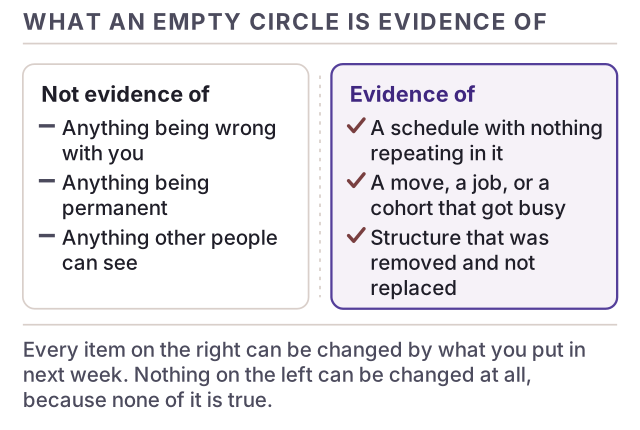
Starting from nobody makes one part of that harder and one part easier. Harder, because there is no existing circle to introduce you and no friend-of-a-friend shortcut available. Easier, because there is nothing to maintain, so all the available effort can go into one thing that recurs.
A realistic first move is narrow: pick one activity with a fixed weekly slot and attend it enough times to stop being new. Imagine two people who each decide to be more social this month — one goes to four different events, the other goes to the same class four times. The second one is the one who will know somebody’s name by the end of it. The mechanism rewards recurrence and ignores variety, which is inconvenient, because variety is what feels productive.
Time is the part nobody wants to hear. A 2018 study in the Journal of Social and Personal Relationships, which surveyed 355 US adults who had moved city within the previous six months and 112 first-year students at the University of Kansas, found that on average roughly 50 hours together preceded someone being called a casual friend and around 90 hours preceded the word friend. Those are averages from self-report rather than a rule, and the study’s own caveat matters as much as the figures: hours of shared leisure did the work, while hours spent working alongside somebody largely did not. The detail and the caveats matter more than the figures themselves, and this site keeps them attached.
What does starting from nobody actually look like?
Slower and less dramatic than the phrase suggests. Laid out as a sequence rather than a timetable, because no honest source can tell you how long any part takes:
Becoming a face. The first stretch produces no friendships and no conversations worth reporting. What it produces is recognition — the nod, the “you again”, the point at which the room stops treating you as new. Most people quit here, conclude the group was closed, and start again somewhere else, which resets the counter.
Becoming someone who gets spoken to. Recognition turns into short exchanges, usually about the thing you are both there for. This is where a shared activity earns its place: it supplies the subject, so neither of you has to manufacture one.
Becoming someone who gets asked. Somebody mentions a plan in front of you rather than to you, and there is an opening. Taking it is easier than starting one, which is why this stage arrives before you have to make the first move yourself.
Making the move. Something specific, soon, and small, aimed at one person rather than the group. This is the only step that requires an explicit bid, and it is the one that decides whether any of the earlier stages amounted to anything.
Two practical notes. Attempts fail often, for everyone, and a single unanswered message is not evidence about your worth — treat it as scheduling information. And one activity attended faithfully will outperform four attended once each, every time, because none of the stages above can start without recurrence.
When is this not a website’s question?
There is a boundary here and it is worth being direct about where it sits.
These pages describe social mechanics: how contact builds, why it stops, what to do next. That covers a great many people who currently have nobody to call and who are otherwise fine.
It does not cover everything. If being alone has stopped feeling like a situation and started feeling like a fact about you; if the thought of contact produces physical symptoms rather than reluctance; if low mood has been continuous rather than occasional; or if the question in your head is really about whether anything is worth doing — that is health, not social logistics, and no article can assess it. A GP or a therapist can. Contacting one is a reasonable step and not an admission of anything.
This site does not diagnose, does not predict, and does not publish figures about mental health. Where a number would answer a question here, we usually do not have one that survived the fact gate, and saying so is more useful than borrowing a statistic from somewhere it did not come from.
What is on the pages in this section
Why do I have no friends takes the causes above and works through them one at a time — what each one removes, and what can be rebuilt in its place. It is the page to read if the question is mechanical rather than emotional.
Is it normal to have no friends deals with the comparison question, and deals with it honestly. It includes what is known about how much a personal network turns over — a Dutch panel study reported by Utrecht University in 2009 found that seven years after the first interview, 48% of the people in someone’s network were still in it, while network size stayed strikingly stable. Turnover, not decline. That page also sets out which widely repeated figures about friendlessness this site refuses to print, and why.
From there, the practical routes live in the other sections: making friends covers building from nothing, and keeping friendships covers the half of the subject that decides whether the next circle lasts longer than the last one.