
People who search this question are usually looking for a flaw. What they typically find, when they reconstruct the actual timeline, is a sequence of ordinary events that each removed a bit of structure — and none of which felt significant while it was happening.
Having no friends as an adult is usually the end state of a sequence of ordinary structural changes — a move, a job change, a relationship that absorbed the evenings, a child, a long break in routine — each of which removed part of the machinery that used to produce friendships without effort.
This page is about those events. Not because circumstances excuse everything, but because the correct explanation determines what you should do next, and the personal explanation sends people in the wrong direction for years.
Why do I have no friends?
Most adults who have no friends lost the structure that used to supply them, not the ability to make them: moves, job changes, a relationship, parenthood and the end of education each remove a piece of the routine contact friendships are built from, and nothing replaces it by default.
Circles rarely collapse in one event. They thin out across years, through changes that each looked minor at the time, which is why the timeline is so hard to see from inside it.
Why do I struggle to make friends?
Making friends is harder in adulthood because the three conditions that used to produce them automatically — the same people, in the same place, repeatedly — are no longer supplied by anything in an ordinary week.
Until your early twenties, friendship was largely automatic. School and university supply three ingredients that together produce friends without anyone trying:
- the same people,
- in the same place,
- repeatedly, on a schedule nobody had to arrange.
Adult life removes all three, usually at once, and replaces none of them. Work looks like a replacement and mostly is not: colleagues are the same people in the same place, but the relationship is bounded by the building, and the friendships tend to end when the job does. The adult arrangements that do supply all three, such as a five-a-side team with a fixed Tuesday slot or a choir that rehearses every Thursday, are the exception rather than the default.
This is the single most important thing to understand about adult friendship. When people say it is harder now, they are not describing a decline in their own likeability. They are describing the removal of an infrastructure.
What causes a lack of friends?
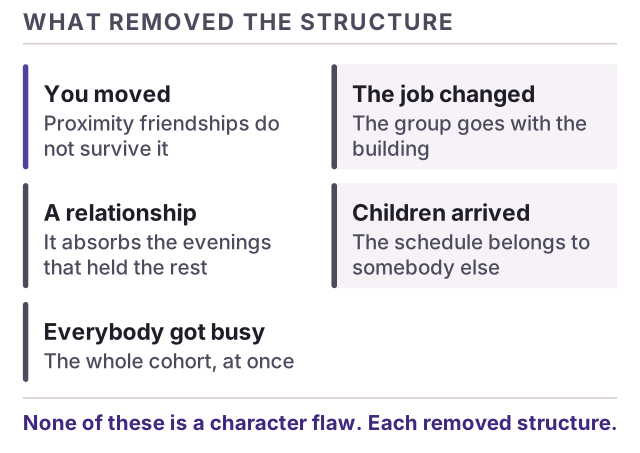
A lack of friends in adulthood is usually caused by an accumulation of ordinary structural events — moving, changing jobs, a relationship, children, and a whole cohort getting busy at once — rather than by anything that happened between you and a particular person.
Most adults without close friends arrive there by some combination of these, not by one dramatic event.
You moved. The most common single cause. Friendships built on proximity do not survive a hundred miles; they become messages, then birthdays, then nothing. Two or three moves in a decade is enough to leave someone with a warm and completely non-local circle. For example, a friendship held together entirely by living two streets apart usually converts into messages within a few months of one person leaving the city, without either person deciding anything.
Your job changed. If a large share of your social contact came from work, changing employers empties the calendar overnight. People are often shocked by how completely a “great group of friends” evaporates within a few months of leaving. Consider a team of five who ate lunch together every working day for three years: when one of them changes employer, the daily contact ends with the door pass, even though nobody’s feelings changed.
You were in a relationship. A relationship absorbs the evenings that used to maintain friendships. Nobody decides to stop seeing people; there is simply less room, and friends stop asking after being declined a few times. If the relationship then ends, the loss is double, and the second half is invisible from outside.
You had children. The schedule reorganises around someone else entirely. Existing friendships without children drift because availability no longer overlaps; new friendships form around the children and are frequently context-friendships that end when the school does.
Everyone got busy at the same time. In the thirties, a whole cohort simultaneously acquires demanding jobs, small children, mortgages and ageing parents. Nobody has withdrawn from you. The available hours across an entire social group collapsed at once.
The pandemic years. A period during which the ordinary attrition of friendships continued while the ordinary replacement of them did not. A lot of people are still short a circle for this reason alone.
Turnover is normal; the size is what is unusual
There is a widely repeated line that you lose half your friends every seven years. It comes from a real study, and it is worth stating properly, because the popular version drops the half that matters.
Utrecht University reported in 2009 on a panel study in which 1,007 Dutch adults aged 18 to 65 were surveyed, and 604 of them re-interviewed seven years later. Only 48% of the people in someone’s network were still in it. Only 30% still held the same position — the same role as someone you discuss things with or turn to for help.
And: the average size of those networks stayed strikingly stable across the same seven years.
That last clause is the whole point. A healthy adult social life is not a fixed cast of people you keep. It is a slowly rotating one, where roughly half the roster changes over years and the number stays roughly constant, because departures are matched by arrivals.
Which reframes the situation precisely. If you have no close friends now, the ordinary mechanism has not failed because you lost people — losing people is normal and continuous. It has failed because the replacement side stopped, and replacement is the part that depends on having somewhere new people appear.
Is it my fault that I have no friends?
Usually not, and where circumstance does not explain everything the difference shows up in the shape of the pattern rather than in anything about your character.
Pretending that circumstance explains every case would be its own kind of dishonesty.
The signal to look for is a pattern that repeats across different contexts. Structural drift leaves a scattered trail: friendships that faded in different cities, at different jobs, for different reasons, none of them ending badly. Something more personal leaves a repeating one — friendships in unrelated places that ended the same way, or a consistent report from different people about the same thing.
Two patterns worth honest examination, because they are common and fixable:
- Never being the one who initiates. If every friendship you have had was started and maintained by the other person, it will look from outside like a slow series of unexplained fade-outs. This is a habit, not a character trait, and it is the single highest-yield thing to change.
- Contact only when something is wrong. If the pattern is long silences broken by needing something, friendships get worn down. Most people accept it for a while and then quietly reduce contact without ever saying why.
Neither of these makes anyone a bad person. Both are learnable.
Where this page stops
There is a version of this question that is not about friendship at all. If you have withdrawn from people you still like, if the thought of contact produces dread rather than reluctance, if this has lasted months and come with changes in sleep, appetite or interest in things you used to enjoy — that pattern is a health question, and this is a website about social logistics.
A GP or a therapist is the right reader for that, and going to one is not an admission of anything. It is also worth saying plainly: loneliness is not a diagnosis, and nothing on this page should be read as one.
What to do with this
If the cause is structural, the fix is structural: not becoming a different person, but rebuilding the thing education used to supply — the same people, the same place, repeatedly. That is the whole content of where adults actually meet people, and of what to do when you are starting from nobody.
If some of your old circle is still alive but dormant, that is the cheapest route back, and it has its own page.