
This question is almost always asked with a particular fear behind it: that having no close friends is unusual, that it says something permanent, and that everyone else is managing something you are not.
Having no close friends is a description of a current social structure rather than a type of person: it means nobody is presently occupying the roles a close friend occupies — someone to do things with, someone who knows the details of your life, someone to call when something goes wrong.
The honest answer has two halves. It is much more common than it appears. And the reason it appears rare has a mechanical explanation.
Is it normal to have no friends?
It is common enough to be unremarkable, and it looks rarer than it is because the evidence you can see about everybody else is systematically edited.
Social life is the most heavily edited part of public existence. For example, nobody posts a photograph of a Saturday spent alone, while a great many people post the one dinner they attended in three months. The result is a systematic distortion: you compare the whole of your life, including all the empty parts, with a highlights reel of everybody else’s.
There is a second layer. Adults almost never disclose this. Admitting to no close friends feels like admitting to a defect, so people with the same situation stay quiet, which makes each of them believe they are unusual. It is a condition that hides itself.
Is it normal to have no friends in your 30s?
It is common in that decade in particular, because demanding jobs, small children, mortgages and ageing parents arrive across a whole cohort at roughly the same time, and the spare evenings of an entire social group collapse together.
Nobody in that situation has withdrawn from you. The hours stopped being available on both sides at once, and friendships that ran on spare evenings went dormant rather than ending.
What the research can actually support
Very little of what circulates on this subject survives contact with its source, so this page is deliberately thin on numbers. Two things can be said with a citation attached.
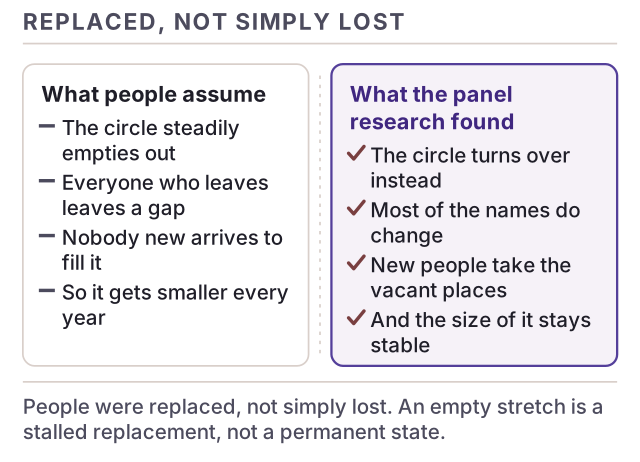
Utrecht University reported in 2009 on a panel study in which 1,007 Dutch adults aged 18 to 65 were surveyed and 604 of them re-interviewed seven years later. Only 48% of the people in someone’s personal network were still in it. Only 30% still held the same position — the same role as somebody you discuss things with or turn to for help.
And the average size of those networks stayed strikingly stable across the same seven years.
Those two findings together are the most useful thing on this page. Adult social life is not a fixed cast you either keep or fail to keep. It is a slowly rotating one: roughly half the people change over several years while the number stays about the same, because departures are matched by arrivals.
Which reframes an empty stretch precisely. If you have nobody close right now, the ordinary mechanism has not failed because you lost people — losing people is continuous and normal. It has failed because the replacement half stopped, and replacement depends on having somewhere that new people appear repeatedly. That is a fixable structural problem, not a verdict.
How many friends does the average person have?
We do not publish a figure for this, because every candidate number failed the source check this site applies: each one arrived without the exact question that produced it, without the population it described, and without a traceable original survey behind the headline.
Most articles on this question open with a figure anyway: the average adult has some specific number of close friends, and some percentage report having none.
The reason for leaving them out matters more than the reassurance would. Different surveys ask different questions, such as “close friends”, “friends”, or “people you discuss important matters with”, and produce wildly different answers as a result. The figures then circulate stripped of their wording, their year and the population they described, at which point they stop being evidence and become decoration.
If a properly sourced figure with its exact question and base is verified for this site, it will appear on the statistics page with the question attached. Until then, the honest position is that the average is not the point anyway. Knowing that some proportion of adults report no close friends does not change what is available to you this month.
Does having no friends mean something is wrong with me?
Usually not: the most frequent causes are a move, a job change, a long relationship and the end of education, none of which are about character.
The questions worth asking are not is my number normal, but:
Is this a stage or a settled state? A gap that followed a move, a break-up, a job change or a new baby is a stage, and stages respond to structure. A situation that has persisted through several different life circumstances is worth looking at more closely. Consider two people with an equally empty calendar: one arrived there after moving cities last spring, the other has had the same gap through three cities and two jobs. The first describes a stage; the second is the one worth examining.
Did you choose this or did it happen? People genuinely vary in how much social contact they want, and some are content with very little. That is a real position and not a rationalisation. The distinction is whether the current arrangement is one you would pick.
What is actually missing? “No friends” covers several different situations: nobody to do things with, nobody who knows the details of your life, nobody to call in an emergency. These have different solutions, and naming which one you mean is more useful than counting.
Where this page stops
Everything above treats this as a social question, because for most people it is one.
If the situation is producing something heavier — if it has lasted months and come with changes in sleep, appetite or interest in things you used to enjoy, or if it has settled into a belief that you are the kind of person nobody wants — that is a health question, and it is beyond what a website should be attempting. A GP or a therapist is the right reader for it, and going is not an admission of anything.
Loneliness itself is not a diagnosis, and nothing here should be taken as one.
What to do next
If the answer is that this is a stage and you want it to end, the two useful pages are why this happens to people who did nothing wrong and the practical version of starting again. If some of your old circle is dormant rather than gone, that is the cheapest route back and it has its own page.