Adult friendship is a voluntary relationship with no structure holding it up: no shared timetable, no institution, no obligation, and no formal way to begin or end it. That single property explains most of what is otherwise puzzling about it — why it is hard to start, why it fades without an argument, and why nobody is ever sure whether one has ended.
Family is given. A romantic relationship has visible milestones and a recognised way to stop. A colleague is supplied by a building. Friendship has none of that scaffolding, which is what makes it valuable and exactly what makes it fragile.
Why is it hard to make friends as an adult?
Because everything that used to be automatic now has to be arranged, and anything that has to be arranged competes with everything else.
School and university supplied three things at once: the same people, the same place, and a repeating schedule nobody had to organise. On top of that they supplied unstructured time — the gaps between obligations, where conversation happens without being planned. Adult life removes all four and hands back a calendar you control.
Control is the trap. Every adult friendship now depends on somebody choosing it, out loud, in competition with work, rest, family and the general fatigue of ordinary weeks. Nothing arrives by default. And because nothing arrives by default, nothing announces its absence either: no alert fires when you have not seen somebody in eight months.
There is a second layer, which is that adults are out of practice at the asking. Being invited to something by a person who is not already close is rare enough that both sides feel self-conscious about it — the one extending the invitation and the one receiving it. The awkwardness belongs to the situation. It is not a signal that the invitation was unwanted.
How do adult friendships actually end?
Almost never in a fight. They end because nobody scheduled the next thing, twice in a row, and then it was a year.
That is worth stating plainly because the two possible endings feel identical from the inside and demand opposite responses. Drift is an absence of decisions: two people who still like each other, whose contact ran on a container that is gone — a job, a course, a neighbourhood — and neither of whom did anything wrong. An ending involves a decision by at least one person, usually about how the friendship was working rather than about a single incident.
Consider the practical difference. Drift is reversed by one message with a specific suggestion in it, and reversed surprisingly often, because the other person has been assuming the same thing you have. An ending is not reversed by a suggestion, and treating it as drift produces the miserable pattern of repeated invitations into silence.
Turnover in a personal circle is normal, and here the numbers are more reassuring than the folklore. A panel study reported by Utrecht University in 2009 re-interviewed 604 Dutch adults seven years after an initial survey: 48% of the people in someone’s network were still in it, and only 30% still held the same position — the same role as a discussion partner or a practical helper. The clause that has to travel with those figures is the one usually dropped: the size of people’s networks stayed strikingly stable over the same period. Networks turn over. They do not simply shrink.
That is a Dutch sample and a university’s own report of the research, not a global law. But it reframes the experience of looking around at forty and recognising fewer faces than at thirty. Replacement, rather than loss, is the ordinary pattern — provided something keeps supplying replacements.
What actually keeps a friendship alive?
A fixture, and a low bar for what counts as contact.
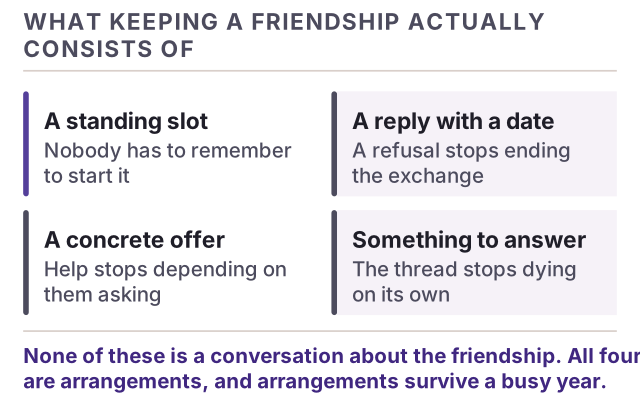
Something that recurs. The friendships that survive adult life are usually the ones with a repeating slot attached: a monthly dinner, a standing call on the way home, a game every Tuesday, a walk on the first Sunday. The content matters far less than the recurrence. For instance, two people who speak for fifteen minutes every fortnight will stay closer than two who intend a long evening every few months and manage it twice a year.
Deciding the next thing while you are still together. This is the single highest-yield habit in the whole subject, and it takes ten seconds. At the end of the evening, put the next one in the calendar. Every friendship that drifted apart did so at exactly this moment, when “we should do this more often” was said instead.
Tolerating asymmetry. Somebody usually organises more than the other, and periods of imbalance are normal — a new baby, a hard year at work, an illness. The question is not whether it is even this month but whether it has been one-directional for a long time across many attempts.
Low-stakes contact between meetings. A message with no agenda. A link. A photograph of something the other person would find funny. These are not substitutes for seeing each other, but they keep the friendship in the foreground so that the next invitation is not arriving out of nowhere.
The reason recurrence beats intensity is that closeness is bought in hours, and hours only accumulate on a schedule. A 2018 study in the Journal of Social and Personal Relationships — 355 US adults who had moved city within the previous six months, plus 112 first-year students at the University of Kansas — found that on average around 90 hours together preceded people calling someone a friend, and more than 200 hours preceded close friend. Those are averages from self-report rather than thresholds anyone crosses on cue, and the study’s caveat is the useful part here: hours of shared leisure did the work, while hours spent working alongside somebody largely did not. A friendship that has stopped generating shared hours is not being maintained, however warm both people still feel about it.
When is a friendship worth stepping back from?
When the pattern, not the incident, is the problem — and the honest test is behavioural rather than a verdict about the person.
Useful questions: does contact reliably leave you worse than it found you, over months rather than after one bad evening? Is your side of it consistently the one adjusting? Have you stopped mentioning things because of how they will be received? Those are descriptions of how a relationship is running, and they are the kind of thing a person can actually check.
What this site will not do is hand out labels for other people. Naming somebody as a category feels decisive and answers nothing, because the useful next step is the same either way: change what you do, see whether the pattern changes, and decide from there. The signs of a bad friend page keeps to that standard throughout.
What is on the pages in this section
How to be a better friend is the maintenance page — the fixtures, the ten-second habit, and what to do when a friendship is genuinely one-sided rather than temporarily uneven.
Growing apart from friends covers the most common ending there is: the sequence by which two people who like each other stop seeing each other, and the point at which it can still be interrupted.
Friendship breakup deals with what happens when it is a decision rather than a drift — including why these endings hit harder than people expect, given that there is no ritual, no announcement, and often nobody to tell.
Signs of a bad friend describes behaviour and its effects, such as contact that arrives only when something is needed, or a pattern of privately relayed remarks, without issuing a verdict on anyone.
How to reconnect with old friends is the cheapest thing in this whole section: what to write after years of silence, and why the message is usually answered.
If the circle needs rebuilding rather than repairing, making friends covers the mechanics of starting, and starting from none covers the situation where there is currently nobody to call.
Where this section stops
These pages describe how relationships between adults tend to work and what tends to help. They are not clinical, they do not assess anyone’s character from a distance, and they cannot tell you what a specific person will do next. Where a friendship involves anyone being frightened, controlled or harmed, that is outside what a guide like this can usefully address, and a professional — a GP, a therapist, or a support service — is the right place for it.