
Almost everything written about the end of a relationship assumes a romantic one. There is a word for it, a set of rituals, a category of song, an expectation that friends will rally and that you might be a bit useless for a fortnight.
A close friendship ends and there is none of that. A friendship breakup is the end of a close platonic friendship: no announcement, no status to change, no one to tell, and an unspoken assumption everywhere around you that it was not the sort of thing that hurts. It is, routinely, one of the more painful losses adults experience, and one of the least accommodated.
Why are friendship breakups so brutal?
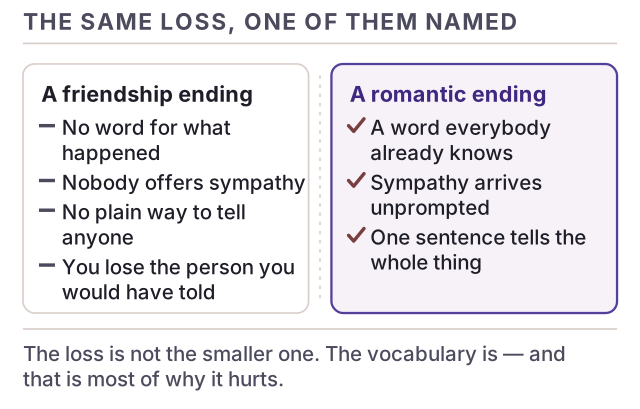
They are brutal because the loss is the size of a romantic one and arrives with none of the apparatus: no word for it, no ritual, no sympathy, and no one to process it with.
The loss is not smaller — the vocabulary is. A close friend of a decade may know more about your life than most family members and have been in daily contact. Removing that removes a large part of the ordinary texture of your week.
You have lost the person you would normally process it with. This is the specific cruelty of the situation. When something bad happens, you call your close friend. Here, the bad thing is the absence of that person, and the reflex keeps firing for months.
There is no permission to grieve. Nobody offers sympathy for something they have not been told is a loss. Most people do not even announce it, because saying “we’re not friends anymore” out loud sounds adolescent — which leaves the grief entirely private.
The ending is often unclear. Romantic endings usually have a moment. Friendships frequently end without one: a slow cooling, one unreturned message too many, an argument that was never resolved but also never named as final. Ambiguity makes closure harder, because there is nothing definite to accept.
The ways they actually end
The fade. Most common, and usually not really a breakup at all — it is drift, and it is often reversible. Worth being sure which one you are looking at before mourning something that has merely gone quiet.
The rupture. A specific incident: a betrayal, a line crossed, something said. Rarer, clearer, and in a sense easier to place, because there is a thing to point at.
The slow imbalance. One person has been carrying the friendship for years — always initiating, always accommodating — and eventually stops. From the outside this looks like the fade; from the inside, one person made a decision and the other never noticed there was one being made.
The life-stage divergence. Nobody did anything. One had children, one moved abroad, one’s circumstances changed beyond recognition, and there was no longer enough overlap to sustain contact. For instance, a friendship built on Friday nights in the same city rarely survives one of you moving two hours away while the other starts nursery runs. These endings are the most common and the least resented, though they still hurt.
The delayed ending. The friendship stopped working years ago and continued out of habit and history. When it ends, the dominant feeling is often relief, followed by guilt about the relief.
How do you end a friendship?
You end a friendship in one of two honest ways: by saying something short and non-accusatory, or by letting contact fade. Both are legitimate, and which one fits depends on whether there is a cause the other person could name.
Say something. Appropriate when there is a specific cause the person could act on, or when the friendship was close enough that silence would be its own cruelty. Keep it short and about you rather than an inventory of their failings: what you need, what is no longer working, what you are doing about it. This is not the moment for a complete case for the prosecution — a list of grievances delivered at the exit does not inform, it convicts, and the other person has no way to respond except defensively. Consider the difference between “I haven’t got room for this the way I used to” and a numbered account of everything they got wrong: the first can be heard, the second can only be defended against.
Let it fade. Appropriate when nothing specific happened and the friendship has simply run out. This is by far the most common route and, contrary to how it is usually framed, often the kinder one. A formal ending imposes an event on something that would otherwise dissolve gently, and it obliges the other person to have a conversation they did not ask for.
The version worth avoiding is the third one: withdrawing while denying it, saying yes to plans and cancelling, being warm in messages and unavailable in life. It keeps the other person waiting on a friendship that has already been decided.
If you are the one who was left
Resist reconstructing the case. The strongest urge is to work out exactly what happened, replaying conversations for the moment it turned. Occasionally this produces something useful. Usually it produces a highly detailed narrative that cannot be verified and keeps the loss fresh.
Do not send the long message. The document that lays out the whole history, everything you did for them, everything they did. It is written for relief and read as an attack, and it forecloses the possibility of anything later.
Expect the reflex. The impulse to tell them things will keep arriving for months, attached to specific triggers — the shared joke, the show you would both watch. For example, a headline they would have found funny will produce the urge to forward it long after you have stopped expecting to. This is normal and fades unevenly.
Tell someone. Even one person. Naming it out loud — “I’ve lost a close friend and it’s knocked me sideways” — converts it from something private and slightly shameful into an ordinary loss. Most people who hear it recognise it immediately.
Do not fill the space immediately. Trying to instantly replace a ten-year friendship with someone new is unfair to the new person and does not work. The rebuilding is worth doing, but as its own project, not as anaesthetic.
How long does a friendship breakup last?
There is no measured figure for this, and anybody quoting one has invented it. What people describe is a fade over months rather than weeks, not in a straight line, with the sharp parts attached to the moments you would otherwise have made contact.
The clearest marker is not that you stop thinking about them. It is that thinking about them stops requiring anything from you.
Can a friendship recover after a breakup?
Sometimes, but not by returning to what it was. Friendships that resume after a real rupture tend to come back smaller and more careful, with less assumed on both sides and less shared. It generally needs enough time to have passed that neither person is still rehearsing their case, and it works better when the first contact is small — an ordinary message rather than a summit about what happened. If the friendship went quiet with no incident behind it, this is a different situation entirely, and drift resumes far more easily than a rupture does.
Where this page stops
Grief over a friendship is ordinary and this page is about the ordinary version. If the loss has settled into something heavier — if it has been months and things are not moving, if sleep or appetite have changed, if it has taken the ground out from under how you see yourself — that is a health question rather than a social one, and a website is the wrong instrument. A GP or a therapist is the right one, and going is not an admission of anything.
If the ending had no incident behind it, it may not be an ending at all: drift is far more common and stays reversible for years. And if what you are facing afterwards is an empty calendar rather than a single absence, start here.