
There is an enormous amount written about making friends and very little about keeping them, which is strange, because most adults lose friendships far faster than they form them. The maintenance half is also the easier half — it costs less, it works more reliably, and the people involved already like you.
This page is about that half. Friendship maintenance is the unglamorous work of keeping an existing friendship alive — initiating, replying, remembering what is going on, turning up — as distinct from the work of starting a new one.
It matters because the cast changes on its own. Utrecht University reported in 2009 that among 604 Dutch adults re-interviewed seven years after an initial survey of 1,007 people aged 18 to 65, 48% of the people in someone’s personal network were still there — while the average size of those networks stayed strikingly stable. The turnover is real and the shrinkage is not, which puts the question of which friendships stay squarely in the ordinary weeks rather than in anything dramatic.
What makes someone a good friend?
Reliability, more than insight: the people whose friendships last are the ones who reply, initiate often enough, remember the specifics and turn up for ordinary things.
Ask people this and you get answers about loyalty, honesty, being there in a crisis. Watch which friendships actually survive a decade and the pattern is more prosaic.
They reply. Not instantly, not always well, but eventually and reliably. A friend who answers within three days every time is worth more than one who sends brilliant messages twice a year.
They initiate. Roughly often enough. Not equally — that never happens — but they are on the list of people who sometimes start things.
They remember the specifics. Not birthdays, necessarily. The interview on Tuesday, the difficult parent, the name of the person causing trouble at work. For instance, asking “how did Tuesday go?” a week after someone mentioned an interview is close to the entire skill.
They turn up for the ordinary stuff. Everyone appears for a funeral. Far fewer come to a leaving-do, a small exhibition, a Tuesday dinner. Attendance at unimportant things is what makes someone feel known.
None of this requires being emotionally gifted. It requires attention, which is more available than most people assume.
The single highest-return habit
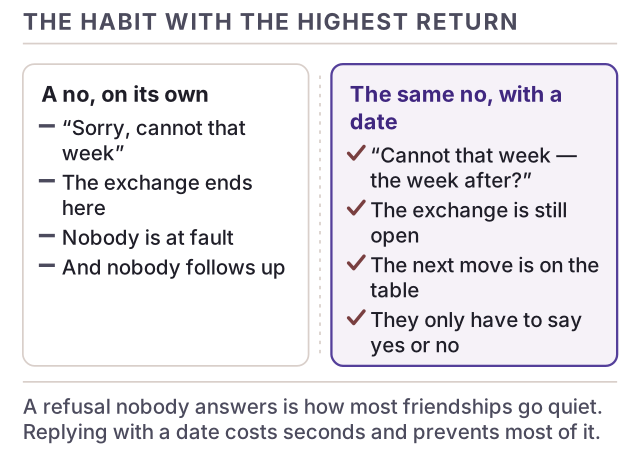
When you cannot make a plan, propose another date in the same message.
That is it. Most friendships do not end in conflict; they end because “sorry, can’t that week” arrived and nothing followed it. Two of those in a row is enough for a friendship to go quiet for a year — this is exactly how drift works.
Answering a no with an alternative keeps the exchange open and takes four extra seconds. There is nothing else on this page with a comparable ratio.
How do you keep friendships alive when everyone is busy?
Attach them to a recurring slot, so that staying in contact does not depend on anyone remembering to initiate.
A friendship maintained by occasional deep evenings is fragile, because any busy period removes the only mechanism. One maintained by a recurring low-effort thread is robust.
The practical version:
- Fix a slot rather than relying on intent. The first Tuesday of the month survives; “we should do this more often” does not.
- Keep a background thread going. Small things such as a link, a photo, a two-line message or an actual question. The purpose is not the content — it is that contact never becomes an event requiring a reason.
- Separate maintenance from occasions. If the only time you see someone is a birthday or a wedding, the friendship is being run entirely on ceremony, and ceremonies get cancelled.
How do you support a friend going through something hard?
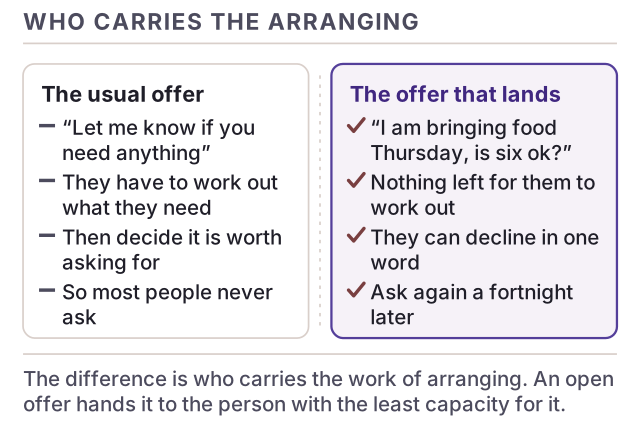
Offer something concrete rather than open-ended availability, because a concrete offer can be declined in one word.
The default offer — “let me know if you need anything” — is well meant and close to useless. It hands the work of asking to the person with the least capacity to do it, and almost nobody ever calls it in.
What lands instead is specific and slightly presumptuous:
- “I’m dropping food round Thursday, is six all right?”
- “I’ll come with you to the appointment if that helps — say no if not.”
- “I’m free Saturday morning to help with the move.”
The difference is who carries the burden of arranging. A concrete offer can be declined in one word; an open one requires the other person to identify a need, evaluate whether it is reasonable, and then ask.
And a fortnight later, ask again. Consider what the second week of a hard period looks like: the messages have stopped, the food has stopped arriving, and the difficulty has not moved. That is the week worth being present for.
Where friendships quietly wear out
Three patterns, all fixable, and none of them makes anyone a bad person.
Contact only when something is wrong. If a friendship is one long series of crises in one direction, it becomes work rather than pleasure. The correction is not to stop asking for help — it is to make sure there are also ordinary conversations, and to ask them about their difficult week too.
Never initiating. From the outside, someone who only ever accepts invitations looks lukewarm, however delighted they are each time. Most people never say this out loud; they simply stop asking. If you know this is you, one initiated plan a month changes how the friendship reads entirely.
Advice instead of listening. The reflex to solve is well intentioned and frequently mistimed. “Do you want thoughts, or do you just want to tell me about it?” is an unglamorous question that prevents most of this.
Accepting unequal effort
In any friendship that lasts, the effort is uneven — usually seasonally. Someone has a new baby, a bad year, a job that eats them alive. During those periods they will contribute nothing and it means nothing.
Keeping score by exchange is a reliable way to lose people who would have come back. The useful frame is longer: over five years, does this go both ways? Over five weeks it never does.
Which is different from a friendship where the imbalance is permanent and one-directional. That is real information, and it is worth noticing without turning it into a grievance — sometimes the honest answer is that a friendship has become a habit rather than a relationship, and there is a page about what that ending looks like.
What about friends you have outgrown?
Not every friendship should be maintained. Some are held together by history and continued out of a sense of obligation to a version of both people that no longer exists.
The test is simple and worth being honest about: do you look forward to seeing them, or do you feel relief when it is cancelled? Consistent relief is an answer.
Letting those fade quietly is legitimate and extremely common. The only thing worth avoiding is letting the ones you do want fade through the same inattention.
Where to go from here
If the friendships you want to keep have already gone quiet, drift explains what happened and reaching out again covers what to say. If the problem is that there are not enough friendships to maintain, the other half of the site starts at making friends as an adult.