
Ask someone how a friendship ended and they will often say they do not know. There was no argument. Nothing was said. They simply cannot identify the last time they saw each other, and it turns out to have been three years ago.
That is drift. Growing apart from friends is what happens when nobody schedules the next thing twice in a row — not a failure mode of adult friendship but its default state, once the structure that used to produce the next meeting is gone.
Why do adult friendships fade?
Adult friendships fade because the shared structure that used to produce the next meeting disappears, and the deliberate scheduling that replaces it has a failure rate.
A friendship needs some mechanism that produces the next meeting. For most of early life, the mechanism is external: you are both in the same building five days a week. Nothing needs deciding.
When the shared structure goes — the job ends, one of you moves, the course finishes, the children arrive — the mechanism has to be replaced by deliberate scheduling. And deliberate scheduling has a failure rate.
Consider the sequence:
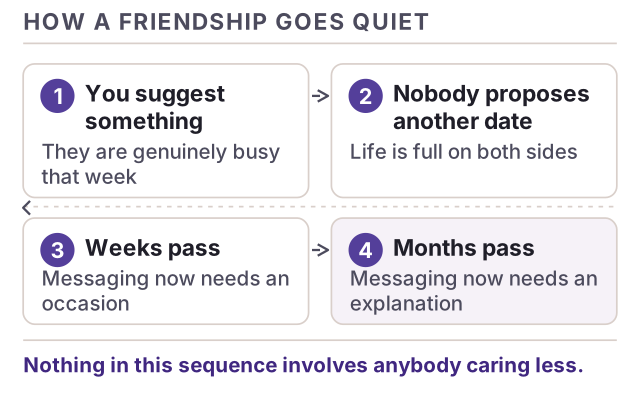
- One of you suggests something. The other is genuinely busy that week.
- Neither immediately proposes an alternative, because life is full.
- Six weeks pass. Messaging now feels like it needs an occasion.
- Six months pass. Messaging now feels like it needs an explanation.
- Both people assume the other one lost interest.
Nothing in that sequence involves anyone caring less. Two declined invitations and a busy autumn are enough to end a friendship that neither party wanted to end.
Is it normal to lose friends in your 30s?
It is the most common decade for it, because everything arrives at once and it arrives for everyone simultaneously.
A whole cohort acquires demanding jobs, small children, mortgages and, increasingly, ageing parents inside the same few years. The result is that the collective free evenings of an entire friendship group collapse at the same time. Everyone experiences it as their friends becoming distant. Almost nobody has become distant on purpose.
For instance, a group that met every Thursday for years can lose the evening altogether inside a single year, once one of them has a baby and another takes a job with evening shifts. Nobody left; the slot did.
This is worth knowing because the alternative interpretation — that people outgrew you, or that you have become boring — is both more painful and less accurate.
How do you know if a friendship is over or just dormant?
A dormant friendship has no incident behind it and answers warmly when contacted, even years later; an ended friendship has a cause someone could name, and contact is answered politely and never returned.
This is the most useful distinction on the page.
A dormant friendship has no incident behind it. Neither person can name a cause. Contact, when it eventually happens, is warm and slightly guilty on both sides. These are extremely common and remain revivable for far longer than people believe — years, routinely.
An ended friendship has a reason, even if it was never said aloud. Someone was hurt, someone changed in a way the other could not live with, or the relationship had become one-sided long before it went quiet. Contact here is polite rather than warm, and never reciprocated.
The mistake is treating the first kind as the second. People spend years assuming a friendship is over because of silence, when silence is only evidence that two adults both have full calendars and neither wanted to be the one who seemed needier.
If you cannot tell which kind you are looking at, one message resolves it faster than any amount of interpretation. Reaching out after a long gap is its own small skill, and it fails softly: an unanswered message leaves you exactly where you were yesterday.
How many friends do people lose over the years?
The familiar line that you lose half your friends every seven years rests on real research and is almost always quoted with the important half missing: the networks turn over, but they do not shrink.
Utrecht University reported in 2009 on a panel study of 1,007 Dutch adults aged 18 to 65, of whom 604 were re-interviewed seven years later. Only 48% of the people in someone’s network were still there; only 30% still held the same position, meaning the same role as a person you discuss things with or turn to for help.
But the average size of those networks stayed strikingly stable over the same period.
So the ordinary pattern is not decline. It is rotation: roughly half the cast changes over seven years while the number stays about the same, because people arriving offset people leaving. Drift is the leaving half, and it is normal. What produces isolation is drift continuing while the arriving half stops — which happens when someone no longer has any setting where new people appear repeatedly.
That is why the answer to drift is rarely “hold on tighter to the people who are going”. It is usually both: maintain deliberately, and keep one structure alive that supplies new people.
What actually prevents drift
A recurring slot beats good intentions. The friendships that survive adulthood are disproportionately the ones with a fixture attached: the first Tuesday of the month, the annual weekend, the Sunday call. Recurrence removes the need for anyone to keep initiating, which is the step that fails.
Low-effort contact between meetings. A friendship maintained only by full evenings will die during any busy period. A thread that ticks over — a link, a photo, a two-line message — costs almost nothing and keeps the relationship from needing an occasion. For example, a photo of something you both used to complain about, sent with no question attached, is enough to keep a thread alive for another month.
Reply to the offer, not just the invitation. When someone suggests a date you cannot make, propose another one in the same message. This single habit prevents most drift, because it stops “no” from ending the exchange.
Accept unequal effort in seasons. In any long friendship, one person carries it for a while — during a new baby, a bad year, a demanding job. Keeping score by exchange is a good way to lose people who would have come back.
When drift is the right outcome
Not every fading friendship should be rescued. Some relationships were built entirely on a context you have both left, and there is nothing underneath. Some have become obligations that neither person enjoys. Some ended for reasons that are perfectly good even if nobody wants to say them.
Letting those go quietly is a legitimate ending, and probably the most common one there is. The point is to make it a decision rather than an accident — to notice which friendships you are letting go of, so that the ones you actually want do not disappear through the same inattention.
Where to go from here
If a friendship has gone quiet and you want it back, how to reach out after a long silence covers what to say. If the ending had a cause rather than a fade, friendship breakups is the more relevant page. And if the pattern is that friendships keep fading and nothing new arrives to replace them, the missing half is somewhere new people appear on a schedule.