About makefriendsguide
Signed Gareth Padfield Editor · started over more than once
How to make friends as an adult, how to turn acquaintances into friends, and what to do when the circle you had has quietly gone. Plain mechanics, no slogans.
One pen name signs it. What that name is answerable for is the method below — plain mechanics, behaviour described rather than people judged, and a clear stop where a question stops being about social life. What it never claims is a licence, a qualification or a private life you could look up.
Who writes this
I edit this site, and the only thing I bring to it is having been at the bottom of it more than once: a city where I knew nobody, a job change that took the last regular faces with it, a stretch where the honest answer to "who would you call on a Tuesday" was nobody at all. None of that qualifies me to tell anybody how to live. It did teach me which advice is written by people who have never had to do it, because that advice always assumes the hard part is the conversation, and the hard part is the second and third time you turn up.
So every page here is built the same way. Name the structure that went missing, because it is almost always structure rather than character. Describe what is actually available to somebody on a Wednesday evening, in the order it can be done. Say what the evidence is when there is evidence, with the organisation that published it and the population it measured in the same sentence, and say plainly when there is none. The two figures this subject repeats most — the hours it supposedly takes, and the friends you supposedly shed — are both traceable, and both are usually quoted with the group they describe stripped off. Where that happens, the page says so.
What this site refuses is as deliberate as what it prints. No verdicts about people: not about you, and not about your friends, because a list of labels to apply to somebody leaves a reader with nothing to do except cut people off. No script that promises a result — the pages on writing to somebody after a long silence give you the shape of a short letter and the reasons it is short, never a formula that guarantees a reply. And no diagnosis, because there is no test for loneliness: it is not a condition this site can measure, and where the real question is about health rather than a social calendar the page names the kind of professional it belongs to and stops there.
What I started with
A new city, a flat with nothing on the walls, and the assumption that this would sort itself out the way it always had. It had always sorted itself out because school and then work had been quietly doing the work: same people, same place, same day of the week. Nothing was doing that any more, and nothing was going to start on its own.
What changed the writing
Noticing that the whole thing is a scheduling problem wearing a personality problem costume. The evenings that produced anybody were the ones I went back to, and the ones I went back to were the ones already in the calendar. After that I could not read a page about being more interesting without asking where, exactly, it expected the same faces to recur.
What these pages refuse
To tell you what kind of person you or your friends are. To hand you a message that promises a reply. To print a number without the group it was measured on. And to answer a health question dressed as a social one: there is no test for loneliness here, and a page that offers one is selling something.
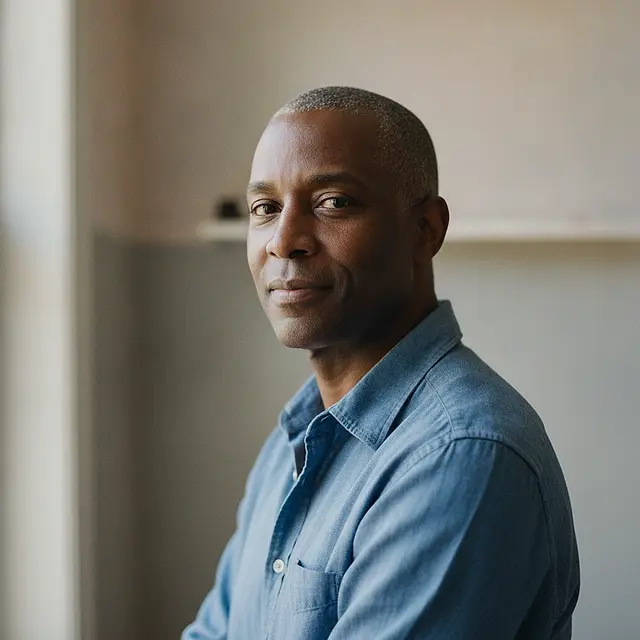
Gareth Padfield is a pen name, and it belongs to this site’s editorial team rather than to a biography you could look up. The name exists so that a page has somebody answerable for it, and not to lend a page weight the text has not earned. There are no credentials behind it: nobody here is a therapist, a counsellor or a coach, nobody here holds a licence or a qualification in anything described on this site, and no page is written as though otherwise. The portrait at the top of this page is not a photograph of a living person — it is an illustration generated with an AI tool, labelled as one wherever it appears, and it is there to give a byline a face rather than to tell you whose. What the name does not claim is a checkable private life: there is no named city, employer, household or diagnosis behind it, no page speaks in the first person about anybody’s health, and no reader is quoted anywhere on this site. What it does claim is narrow: the experience of having had to build a circle from nobody more than once, and responsibility for the method — plain mechanics, behaviour described rather than people judged, and a clear stop where a question stops being about social life. Drafting is AI-assisted and human-edited, every figure is traced to the organisation that published it and carries the population it measured, and if a sentence here is wrong the fastest route to fixing it is hello@makefriendsguide.com with the page address and the sentence you are disputing.
The same rule stated as policy, with what it forbids: bylines and pen names.
How we work
Our process, sourcing rules, and corrections policy are documented in the editorial policy. Every number we publish links to a primary source on the sources page, and appears with the group it was measured on in the same sentence. There are no verdicts about people here — not about you and not about your friends — and where a question is really about health rather than a social calendar, the page says so and names the kind of professional it belongs to.
Contact
Email us at hello@makefriendsguide.com or use the contact page.