
Ask the internet where to meet people and you get a list: gyms, classes, volunteering, meetups, apps, dog parks, church, running clubs. The list is not wrong. It is just unsorted, which makes it useless — the options differ enormously in how well they work, and the difference has nothing to do with how interesting they sound.
Meeting new people as an adult is a venue problem before it is a social one, and there is one property that decides which venues work.
What makes a place good for meeting people?
A place is good for meeting people when you go back to it on a schedule and the same people are there when you do.
Do you come back, and are the same people there when you do?
That is the whole test. Friendship is built from repeated low-stakes contact, so a venue’s value is set almost entirely by its return rate. A place where you see forty new people once is worse than a place where you see the same six people eight times, even though the first sounds far more social.
This single criterion reorders the standard list dramatically.
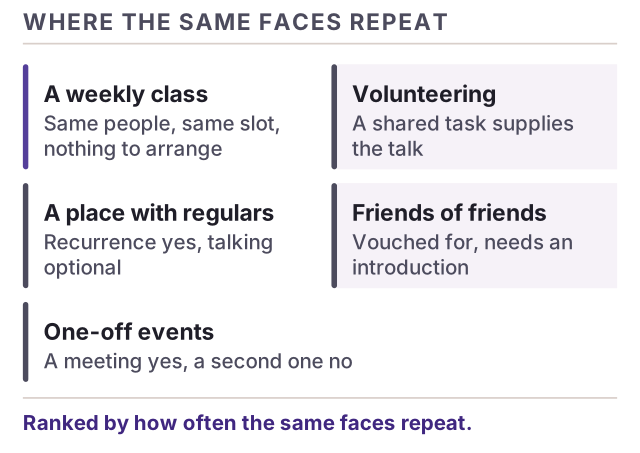
The inventory, sorted by return rate
Strongest: fixed-schedule, fixed-membership activities
Fixed-schedule activities such as a weekly class, a team sport, a choir, an amateur orchestra, a regular volunteer shift, a book group, a martial arts club or a community garden. All of these tick every box: you go back, the same people go back, and there is a shared activity that supplies conversation without either of you having to invent it.
If you take one thing from this page: pick one of these, commit to eight weeks, and treat attendance as non-negotiable. That single decision does more than any amount of conversational technique.
Strong: anything that produces something
A group project, a repair café, a build, a play, a campaign, a mutual-aid rota. Shared work is the best social lubricant there is, because it removes the pressure to be interesting. You are both looking at the thing rather than at each other.
Good but slower: places with regulars
The same café at the same hour, a local pub quiz, a swimming session, a dog park. There are regulars, but nothing forces interaction, so the timescale stretches from weeks into months. Better for people who are patient and nearby.
Moderate: friends of friends
Efficient, because somebody has already vouched for both parties, and it comes with a natural second occasion built in. It is underused mostly because it requires asking a friend to introduce you, which feels like an admission. It is not one — most people are pleased to be asked.
Weak: one-off events
Festivals, conferences, parties, single-session workshops, most one-off meetups. You can have a genuinely good conversation and then never see the person again, because nothing brings you back into the same room. If you use these, the entire value is in getting contact details and making a plan within a few days, before the memory fades.
Weak: general gym membership
High frequency, near-zero interaction. Most people are alone, on a machine, wearing headphones, and both of you know that interrupting is unwelcome. Classes and climbing are different animals entirely — they have a fixed group and forced cooperation.
Situational: friendship apps
They solve the meeting problem cleanly and leave the harder half — the second and third meeting — exactly where it was. Useful when you have just moved and know nobody; less useful as a substitute for a repeated activity. There is a separate page on what the apps actually do.
Why does “just put yourself out there” fail?
“Just put yourself out there” fails because it prescribes exposure without repetition. Imagine someone following that advice to the letter: a gallery opening one week, a stranger’s party the next, then a one-off pottery class, then a networking evening. High effort, high discomfort, and almost no chance of a friendship, because they never see anyone twice.
The same effort spent going to the same thing eight times produces a completely different outcome. Familiarity does the work that charisma is supposed to do. You do not need to be memorable if you are simply there every Tuesday.
Instead of put yourself out there, the operative instruction is: go back.
How long before it starts working?
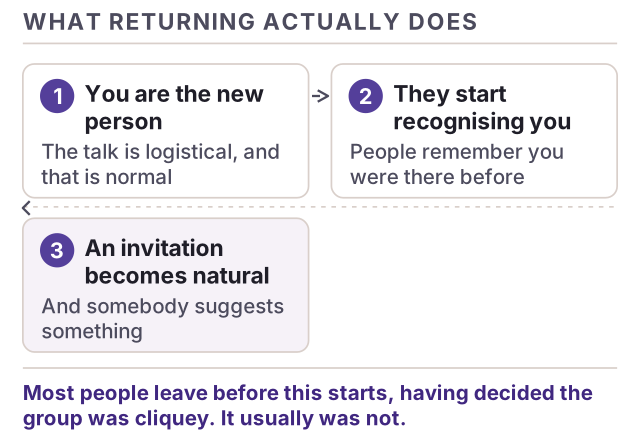
A weekly activity usually starts working somewhere around the fourth to sixth visit, which is slower than it feels like it should. A rough sequence:
- Visits 1–3. You are the new person. Conversation is logistical. This phase feels discouraging and tells you nothing.
- Visits 4–6. Recognition. People nod, remember your name, ask whether you were there last week. Nothing has happened yet, but the ground has changed.
- Visits 7–10. Actual conversations, in-jokes, someone saves you a seat. This is where an invitation to something outside the activity becomes natural.
Most people quit somewhere in the first phase, having concluded the group was cliquey. It usually was not; they simply left before the mechanism started.
For a sense of scale, one 2018 study in the Journal of Social and Personal Relationships found that 355 US adults who had moved city within the previous six months, and 112 first-year students at the University of Kansas, averaged roughly 50 hours together before describing someone as a casual friend — and that hours of shared leisure did that work, while hours spent working alongside someone largely did not. A weekly two-hour class delivers that in something like six months. That is not a discouraging figure — it is a reason to choose a venue you will still be attending in six months rather than the one that sounds most impressive.
What about cost and time?
Cost and time decide attendance more reliably than enthusiasm does, so choose a venue on logistics before appeal:
- Near you. For example, a brilliant group forty minutes away loses to a decent one down the road, because you will actually attend the second one in February.
- Same day, same time. Recurring slots survive; “whenever I can make it” does not.
- Cheap enough to be boring. If a venue costs enough that you have to justify each visit, you will start skipping, and skipping resets the recognition clock.
Where this leaves you
Pick one thing from the top of the list, near your home, on a fixed evening. Go eight times. Talk to the same two or three people rather than someone new each week. Then, once someone feels familiar, make the move that turns an acquaintance into a friend — one specific, small invitation outside the venue.
If you have just moved somewhere and are starting from zero, the sequencing is different and there is a page for that. If the barrier is not knowing where to go but the dread of going, start here instead.