
Most advice about making friends assumes the hard part is logistics — that you simply need to be told where people gather. For a large number of people, the logistics were never the problem. They know exactly where to go. Going is the problem.
Social anxiety is dread attached to the social situation itself — arriving, being seen, having to talk — rather than to the question of where to go. The phrase is used here in that everyday sense; where it stops being an everyday matter is set out at the end. What follows is about arranging things so that the going costs less. It is not about becoming a different kind of person, and it does not treat quietness as a defect to be corrected.
What are the best activities for people who find socialising hard?
Anything side-by-side rather than face-to-face, with a shared focus and a fixed group that meets again next week.
The difficulty of a social setting is largely a function of how much unscripted conversation it demands. That varies enormously, and choosing well matters more than any technique.
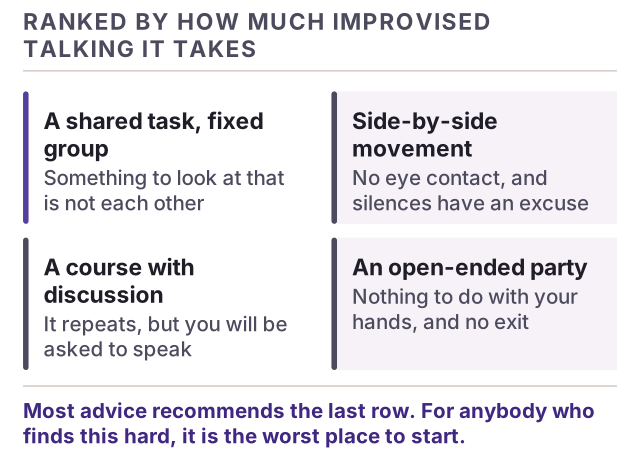
Easiest: a shared task with a fixed group, such as volunteering, a workshop, a rehearsal, a build, a climbing session or a board-game night. There is a thing to look at that is not each other, silences are unremarkable, and conversation happens in short bursts around the activity. If it also meets weekly with the same people, it is the best format available.
Also good: side-by-side movement. Walking groups, running clubs, cycling. Talking while moving forward removes eye contact and gives every silence an obvious excuse.
Harder: courses with discussion. Better than parties, because attendance repeats and there is a subject. Worse than task-based settings, because at some point you will be asked to speak.
Hardest: open-ended social events. Parties, mixers, networking, most large meetups. Nothing to do with your hands, no structure, no defined exit, and the entire event consists of improvised conversation with strangers. This is the format most advice recommends and it is the worst possible starting point.
The instruction put yourself out there usually means the last category. It is bad advice for most people and particularly bad here.
Does making friends get easier with practice?
The specific situations do: the same room with the same people gets easier every time you return to it, even though a new setting stays as hard as ever.
The single most useful fact: most of the discomfort in a social setting comes from unfamiliarity, not from people. The same room, the same faces, the same evening, four weeks running, is dramatically easier by week four — not because you have learned anything, but because the situation has stopped being novel.
This inverts the usual strategy. Rather than pushing yourself through many different events, pick one thing and attend it repeatedly. It costs less in total discomfort and produces far more, because familiarity is exactly the ingredient friendship needs.
It also removes the need to be impressive. If you are simply there every Tuesday, you become a known quantity by default, and being a known quantity is most of what early friendship is.
How do I handle the anxiety before a social event?
Reduce the unknowns: know when you are arriving, roughly when you are leaving, and how you get home.
Know your exit before you arrive. A defined end — “I’ll leave at half eight” — makes an event a bounded task rather than an open-ended risk. A bounded task is repeatable.
Arrive early rather than late. Counterintuitive and reliable. Imagine walking into a room with four people in it, then imagine entering the same room once it is full and loud: the first is a conversation, the second is an entrance. The people who arrive early also tend to talk to each other.
Have two questions ready. Not a script — just a couple of openers about the activity itself. “How long have you been coming?” and “how did you get into this?” cover most first conversations, and both hand the talking to the other person.
Give yourself a small, specific target. For example, one conversation with anyone in the room, after which you are allowed to go home. Vague goals like “be more social” cannot be met and therefore always end in failure.
Take a job. Handing out things, setting up chairs, keeping score, making the tea. A role gives you a legitimate reason to be there, something to do with your hands, and a natural excuse to talk to everyone briefly.
Online first, if that helps
Text-based communities remove nearly everything difficult about first contact: no real-time pressure, no eye contact, time to think, and an easy exit. For many people the sequence online interest group → occasional voice or video → local meetup is far more workable than starting with a room full of strangers.
Two caveats worth being honest about. First, online contact rarely becomes close friendship on its own without some move toward voice or presence. Second, it is very easy for online communities to become the thing that replaces the attempt rather than the on-ramp to it. Both are true; the on-ramp still works.
What not to do
Do not treat alcohol as the tool. It genuinely lowers the barrier and it teaches you nothing, which means the difficulty is unchanged the next time and now attached to a condition.
Do not rehearse conversations in advance. Scripts break the moment someone answers unexpectedly, and preparation increases the sense that this is a performance with a possible failure.
Do not audit yourself afterwards. The post-mortem where you replay everything you said is the most reliable way to make the next attempt harder. What you remember as awkward was, in almost every case, unremarkable to everyone else.
When is social anxiety more than shyness?
When it is persistent, produces physical symptoms, and leads to avoiding things you actually want to do. At that point it is a health question rather than a social-skills one, and a GP or a therapist is the right place to take it — not an article.
Everything above is about ordinary reluctance: finding social situations tiring, disliking small talk, needing more warm-up than other people appear to.
It is not about a social anxiety disorder, and the distinction is real rather than diplomatic. If the anxiety is persistent, if it produces physical symptoms — a racing heart, nausea, shaking — before ordinary interactions, if it leads to avoiding things you actually want to do, or if it is affecting work, study or relationships, that is a health question. It has effective treatments, and it is not something an article about meeting people can address.
A GP or a therapist is the right reader for that, and going to one is not an admission of anything. Nothing on this page is a diagnosis, and nothing here should be used as a reason to postpone asking.
Where to go from here
If you want the format question in more detail, where adults actually meet people ranks venues by how much repetition they supply. If you have already got familiar faces and the missing step is the invitation, that is a different and very specific skill.