
Work friendships are friendships that grow out of daily proximity to colleagues and are held together by the shared context of the job. Work is the one adult setting that still supplies the ingredient friendship needs most: the same people, in the same place, repeatedly, without anyone arranging it. For a lot of adults it is the only such setting they have.
It also comes with conditions nothing else has — a hierarchy, an audience, and a built-in expiry date. Both halves of that are worth taking seriously.
Do work friendships last after you leave?
Only the ones that already existed outside work.
The forming is easy for an obvious reason: you are together for thirty-odd hours a week, sharing problems, with endless small opportunities for conversation. Familiarity accumulates whether anyone intends it or not.
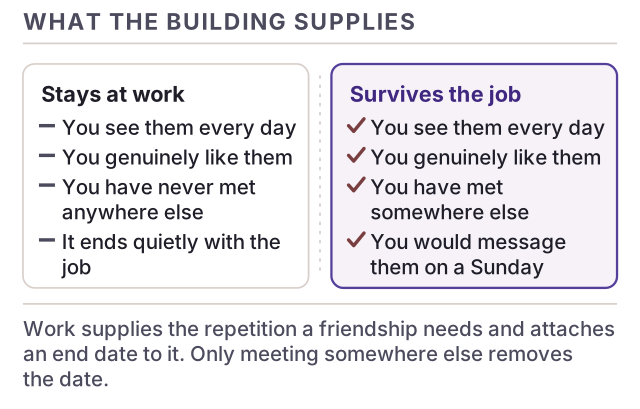
The ending is easy for the same reason. The relationship is being produced by the building. Take away the building and there is often nothing underneath — no shared activity, no reason to meet, no habit of contact that does not involve a desk. This is why people leave a job where they had “loads of friends” and find, six months later, that they speak to none of them.
There is a hint of why in the research on how friendships accumulate. A 2018 study in the Journal of Social and Personal Relationships, which asked 355 US adults who had moved city within the previous six months and 112 first-year students at the University of Kansas about the people they had grown close to, found that hours of shared leisure were what moved those relationships along, while hours spent working alongside someone largely did not count for the same thing. Time at adjacent desks is not the same currency as time spent doing something together, which is why a year of it can leave less behind than a handful of weekends would.
That is not a failure. It is what a context-friendship is. The distinction that matters is whether a particular one has ever been moved outside the context — because that is the only thing that makes it survive a resignation.
How do you make friends with colleagues?
Use the small recurring moments rather than the organised events, and then, at some point, propose something outside work hours.
The small recurring moments, not the organised events. The coffee run, the walk to the station, lunch away from the desk, the ten minutes before a meeting starts. Friendships form in these far more than at the away-day or the Christmas party, which are performances with an audience.
Eat away from your desk, with someone. The single highest-yield habit available in an office. Lunch is unclaimed, low-stakes, and long enough for a real conversation.
Say yes early on. In a new job, accept the drinks, the leaving-do, the birthday thing — especially in the first couple of months, while you are the new person and being included is automatic. People who decline three times stop being asked. Imagine the first month in a new job: the drinks, the leaving-do and the birthday thing all arrive unprompted, because including the new person is automatic — and that window closes quietly.
Ask about the work first. The easiest openers are professional: how something is done, why a thing is the way it is, what happened before you arrived. Nobody minds explaining, and it establishes conversation before anything personal.
Then, at some point, go outside. A coffee that is not the office coffee. A walk. A drink after. This is the step that converts a colleague into a friend, and it is exactly as awkward here as it is anywhere else.
The complications, plainly
The audience. Everything happens in front of other people, and a two-person friendship in an office is visible in a way it is not elsewhere. Being seen as a clique is a real risk, and the correction is easy — keep including other people occasionally. For instance, two colleagues who always take lunch together and never ask anyone else start to read as a closed pair, which is simple to fix and uncomfortable to be told about.
The hierarchy. A friendship across a reporting line is not forbidden and does need care. Both parties should assume that at some point one of them will have to make a decision that the friendship makes harder. Being explicit about that early is better than discovering it during a review.
The venting trap. The most common way work friendships go wrong. Shared complaint is a powerful bonding agent and an unreliable one: it produces closeness fast, it makes the relationship dependent on grievance, and anything you say may travel. A useful rule of thumb: do not say anything about a colleague you would not repeat with them present.
The end date. Someone will leave. If the friendship has never existed outside work, that is usually the end of it — worth knowing in advance, because it is the reason to make the outside-work move sooner rather than later.
How do you make friends in a remote job?
Deliberately, because none of it happens by accident.
Remote and hybrid jobs remove the small recurring moments almost entirely, and the friendships that would have formed in the corridor simply do not form.
What partially replaces them:
- Take the optional calls. The coffee call, the non-work channel, the social half hour. These feel forced because they are — they are a deliberate substitute for something that used to be free.
- Propose a one-to-one with no agenda. “Fancy a fifteen-minute call about nothing in particular?” is unusual and lands well, because most people miss the unstructured contact too.
- Use the non-work channels. If there is a place for photographs of dogs and complaints about the weather, use it. That is where the personal register lives in a remote company.
- Meet anyone who is near you. Geographic overlap in a distributed team is rare and worth acting on immediately.
What if my workplace is not social at all?
Treat it as a poor source and spend the effort somewhere structurally better.
Some workplaces do not produce friendships regardless of effort, such as those with high turnover, shift patterns that never overlap, isolated roles, teams spread across time zones, or an atmosphere where everyone is competing.
If that is the situation, the useful move is to stop trying to extract a social life from it and put the effort somewhere structurally better. Somewhere that meets weekly, near your home, does the same job as a friendly office and does not end when you change employer.
It is also worth remembering the general risk of a work-only social life: if most of your friendships are colleagues, a single job change empties the calendar at exactly the moment you have least capacity to rebuild it.