
Search this subject and you get lists of adjectives — labels to apply to a person, usually with an instruction to cut them off. That approach fails for two reasons. It asks you to make a permanent judgement about someone’s character from limited evidence, and it gives you nothing to do except leave.
This page uses a different unit. Friendship red flags are repeated behaviours that reliably leave one person worse off — not a category of person but a pattern, which means they can be observed, described and acted on. Not what someone is, but what keeps happening.
Is it normal for friends to make you feel bad sometimes?
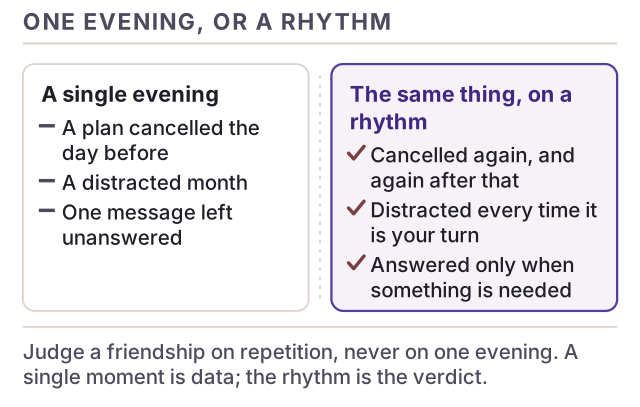
Yes — everybody is occasionally a poor friend, and one bad evening carries almost no information. People cancel, forget, are self-absorbed during a bad month, say the wrong thing, fail to ask how you are because they are drowning in something you do not know about.
None of that means much on its own. What means something is the same behaviour, from the same person, across different circumstances, over months. Before deciding anything, it is worth asking two questions: has this happened at least three or four times? and does it happen regardless of what is going on in their life?
If the answer to both is yes, you are looking at a pattern rather than a bad week.
What are the biggest red flags in a friendship?
The patterns worth noticing are effort that runs in one direction, plans that happen only when it suits the other person, private things that travel, good news that gets deflated, and a consistent sense of being worse off afterwards.
Contact runs one direction. You initiate every plan, ask every question, send every check-in. The test is blunt but clear: stop for a month. If nothing arrives, the friendship was being held up entirely by you. That is a fact about the structure, not proof of malice — some people genuinely never initiate with anyone — but it tells you what you are maintaining.
Plans exist only when it suits them. You are available on their terms, at short notice, when their other options fall through; your suggestions are met with vagueness. Over time this is the shape of being a backup rather than a friend.
Private things travel. You find out that something you said in confidence has been repeated. For example, a detail you mentioned once about your job comes back to you a month later from a third person. Once may be carelessness. Twice tells you what this friendship can safely hold, and you can act on that information without ever having a confrontation.
Your news gets deflated. Good news is met with a comparison, a correction, or a swift return to their own subject; difficulties are met with impatience. The tell is not the odd distracted response but the direction: whether things you are pleased about survive contact with this person.
Your worries are used later. The thing you admitted about your marriage or your work reappears in an argument. This is the pattern most worth taking seriously, because it makes honesty unsafe, and a friendship where you cannot be honest has already stopped being one.
Everything is a competition. Not overt point-scoring — subtler. Every account has a matching, slightly larger version. Being around it is exhausting in a way that is difficult to name at the time.
You are consistently worse off afterwards. The most reliable indicator on this page, and the one people ignore longest, because it feels unfair to reduce a person to how they make you feel. Do it anyway: if you regularly leave feeling smaller, that consistency is the data.
What is the difference between a bad friend and a busy friend?
A busy friend is unavailable and glad to hear from you, and the warmth survives the gaps; the difference shows over months rather than in any single exchange.
Half the value of a list like this is what it excludes.
Being bad at texting. Enormously common, almost never meaningful. Plenty of people are warm in person and hopeless on a phone.
Going quiet for months. Usually drift, which is the default state of adult friendship and rarely a decision anyone made.
Not asking about your life during their crisis. During a divorce, a bereavement, a new baby or a breakdown, people have no surplus. Judging a friendship by its worst six months is a good way to lose good friendships.
Different communication styles. Someone who does not do emotional conversation is not necessarily withholding — some people show up with practical help instead, such as a lift to an airport or an afternoon spent shifting furniture, and that is a real form of care even when it is not the one you would have chosen.
Having other friends. Not everyone will make you their first call. That is not a betrayal.
Should you confront a friend about their behaviour?
If you want the friendship to continue, yes — once, briefly, and about one specific thing rather than an accumulated list.
One short conversation is worth more than months of interpretation. The version that works is narrow:
- One example, recent and concrete. Not a history.
- What it did, not what it proves. “When that came up in front of everyone I felt got at” rather than “you always undermine me”.
- What you would like instead. Something they can actually do.
Consider the difference between “when that came up in front of everyone I felt got at” and “you always undermine me”: the first describes a moment someone can answer for, the second describes a person and can only be denied.
Then listen to the response, which is the actual information. Someone who takes it in, even clumsily, is a friend having a bad pattern. Someone who turns it around so that raising it becomes your offence has told you what future conversations will be like.
What does not work is the accumulated list delivered at once. It arrives as a prosecution, and the other person will spend the whole conversation defending rather than hearing.
Why this page avoids the word people usually use
The popular label has become a description of a person rather than of behaviour, and once it is applied there is nothing left to do but leave. That is fine when leaving is right, and unhelpful the rest of the time — which is most of the time.
Naming the behaviour keeps the options open: talk about it, reduce the friendship to a smaller size, or end it. Naming the person forecloses two of the three.
Some patterns are more than difficult behaviour — sustained control, isolation from other people, pressure that leaves you afraid. That is not a friendship problem and this page is not the right resource for it; a professional or a support service is.
What to do with a pattern you have decided is real
Three options, all legitimate:
- Say the specific thing and see what comes back.
- Resize the friendship. Not everyone has to be a close friend. Plenty of people are perfectly good company for a specific context and unreliable everywhere else, and you are allowed to place them accordingly without an announcement.
- Let it end. Either by fading or by saying so, which is a page of its own.
The thing not to do is stay while keeping a ledger. A friendship being audited in silence is already over; it is simply taking longer and costing both people more.