
Online friendship is friendship built and kept up mainly through the internet — a server, a forum, a game, a long-running group chat — rather than through meeting in person. There is a version of this subject that is entirely about apps designed for meeting people. That has its own page. This one is about the rest of the internet, which is where most durable online friendships actually come from — and where they come from almost by accident.
Where do you meet people online who are not on dating apps?
In interest communities: servers, forums and groups built around a hobby, a game, a craft or a profession rather than around meeting people.
A friendship app introduces two strangers who have both declared they want friends, then leaves. An interest community does something structurally different: it puts you in the same place as the same people, repeatedly, around a subject.
Which is precisely the offline formula. Same faces, shared activity, recurrence — except geography is no longer a constraint.
This is why so many strong online friendships come from places nobody joined to make friends, such as a game guild, a hobby forum, a Discord server for a craft, a professional community or a group for people in a specific situation. Nobody arrived looking for friendship, so nothing is loaded, and the friendship forms as a by-product of showing up.
Practically: if you want online friends, do not go looking for online friends. Go and participate in something.
What makes a community actually work
It has regulars. A huge server where thousands post once is a feed, not a community. A small one with forty people who are all there every week is where friendship happens. Small and active beats large and busy.
It has recurring events. A weekly session, a monthly challenge, a shared game night, a reading schedule. This is the online equivalent of the fixed Tuesday slot, and it does the same work. Consider a server where the same handful of people play every Wednesday evening: after a couple of months you know them, and nobody had to arrange anything.
Conversation is possible, not just posting. Places built around broadcasting — most large social platforms — produce audiences rather than relationships. You want somewhere replies are normal and threads continue.
It survives your absence. If you can be away for two weeks and pick things up again, the community has enough continuity to sustain a friendship.
How do you turn an online acquaintance into a friend?
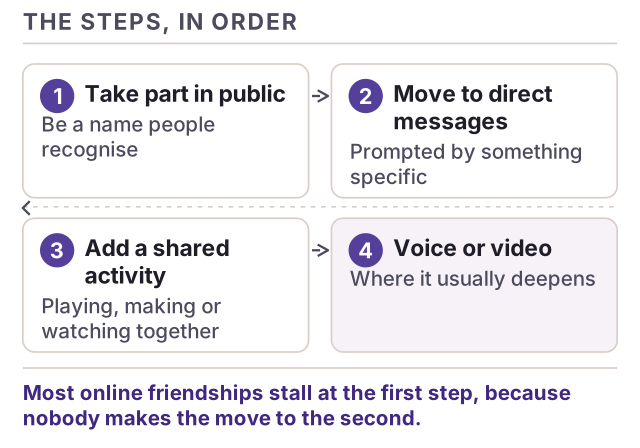
You move the contact out of the public channel in small steps: direct messages first, then something you do together, then voice or video if it fits.
There is a fairly consistent sequence, and each step is small.
- Participate in public for a while. Reply to things, contribute, be a name people recognise. This does the same work as attending a class eight times.
- Move to direct messages. Usually prompted by something specific — a question, a shared reference, continuing a conversation the channel moved past.
- Add a shared activity. Playing together, working on something in parallel, watching the same thing. This matters more than it sounds: two people talking have a conversation; two people doing something have a friendship forming.
- Move to voice or video, if it fits. The point at which online friendships tend to deepen sharply. Text keeps people in a curated register; a voice does not.
- Meet, if geography ever allows. Not required, but it changes the relationship when it happens.
Most online friendships stall at step one because nobody makes the move to step two — the same escalation problem that stalls offline acquaintances, in a different medium.
Are online friendships enough on their own?
They cover conversation and shared interest well and anything requiring presence badly, which is why they work best as one part of a social life rather than the whole of it.
Well: conversation, shared interest, being known in detail, availability at odd hours, and reach — you can find people who share something specific that nobody within fifty miles does. For people whose local options are limited by geography, health, caring responsibilities or schedule, this is not a consolation prize.
Badly: anything requiring presence. Help with a move, someone in the waiting room, sitting with you in silence. Online friendship also tends to be narrower — built around the subject that brought you together — unless it is deliberately widened.
The realistic position is that online friendship is a genuine and valuable part of a social life rather than a full substitute for one. Both halves of that sentence matter.
The failure mode worth naming
Online communities are excellent at producing the feeling of a social life while the local situation stays exactly where it was. There is conversation every evening, people who notice when you are absent, and inside jokes — and also nobody within reach if something goes wrong. For instance, an evening spent across three busy channels can feel like a full social life and still leave nobody to ask on a flat Sunday afternoon.
This is not an argument against online friendship. It is an argument against letting it be the reason you never join anything local. If both are available, both are worth having.
The clearest sign of the trap: several hours of contact every day and nobody you could call to help you move a sofa.
How do you stay safe making friends online?
Keep identifying details back until trust has been built over time, be wary of anyone who moves very fast emotionally, and treat any request for money as the end of the conversation.
The ordinary precautions, held lightly:
- Keep identifying details back at first — full name, employer, precise location. Not because everyone is dangerous, but because there is no reason to hand them over early.
- Be wary of speed. Someone who is intensely close after three days is a pattern worth noticing, in any medium.
- Nobody legitimate asks for money. No exceptions worth entertaining.
- Use the platform’s own tools for as long as they are useful rather than moving to personal contact details immediately.
- If you meet in person: public place, own transport, tell someone where you are going.
Where to go from here
If what you want is specifically local and in person, the venue ranking is on where adults actually meet people. If the difficulty is that in-person settings are hard rather than unavailable, there is a page for that — and starting online is one of the routes it recommends.